
In Liberty Hill ISD, attendance is not treated as a student compliance issue; it’s addressed as a system-level responsibility.
Led by Sandy Scott, Attendance Dropout Prevention Coordinator, the district reframed its approach around a clear principle: Attendance improves when barriers are removed, not when pressure is increased.
With this shift, Liberty Hill ISD built a structured, data-informed system that aligns people, processes, and interventions to identify and address the root causes of absenteeism early.
At the center of this system is the Attendance Behavior Improvement Plan (ABIP).
Attendance as a Systems Issue
Rather than asking, “Why aren’t students showing up?”, the district reframed the question:
What is preventing attendance, and how do we remove it?
This shift moved the work from reactive enforcement to proactive problem-solving. Attendance is now approached through:
- Clearly defined processes across tiers
- Shared ownership across campus and district teams
- Consistent, barrier-focused interventions
Leadership plays a critical role in reinforcing this approach, setting expectations for supportive, relationship-centered, and prevention-driven practices.
A Tiered System That Identifies and Responds Early
Liberty Hill ISD operationalized its strategy through a tiered framework aligned with a Multi-Tiered System of Supports (MTSS).
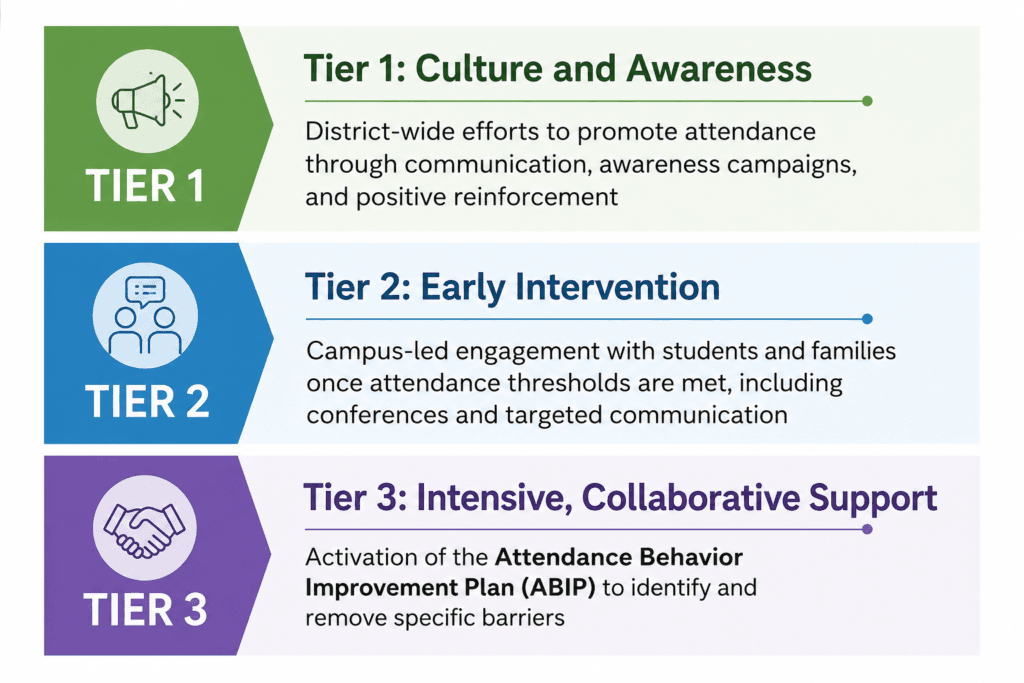
This structure ensures that support increases in intensity as needs become more complex without defaulting to punitive measures.
The impact is clear:
- 63% reduction in absences after the first intervention
- 65% reduction after the second
- Only 23% of students required truancy referrals at the highest level
ABIP: From Intervention to System Coordination
The Attendance Behavior Improvement Plan is not a standalone document; it’s a structured process embedded within the district’s broader system.
Each ABIP is built through:
- Collaborative planning involving students, families, and campus teams
- Barrier identification grounded in data and direct conversation
- Targeted interventions aligned to root causes
- Ongoing progress monitoring with clear timelines and accountability
Structured conferences prioritize listening over lecturing, ensuring that student voice and family context shape the plan.
This approach transforms interventions from generic responses into precise, actionable support strategies.
Barrier-Based Problem Solving in Practice
What sets Liberty Hill ISD apart is its commitment to identifying barriers across the full ecosystem affecting attendance.
These include:
- Student-level: anxiety, depression, academic frustration, peer conflict
- Family-level: transportation challenges, caregiving responsibilities, housing instability
- School-level: disengaging instruction, climate, relationships, safety concerns
- Community-level: poverty, healthcare access, language barriers
Interventions are directly aligned to these barriers. For example:
- Transportation issues are addressed through route adjustments or carpool coordination
- Anxiety supported through gradual re-entry plans and counseling referrals
- Family instability is connected to community-based resources
This is the “magic” of ABIP: barrier-based problem solving that is specific, coordinated, and responsive.
Consistency Through Structure and Training
To scale this approach, Liberty Hill ISD prioritized consistency across campuses.
The district focused on:
- Standardizing ABIP processes and expectations
- Training staff on barrier-based conversations
- Providing clear tools, reference guides, and talking points
- Ensuring ongoing coaching and support
This reduces variability and ensures that every student receives a consistent level of intervention, regardless of campus.
Data and Documentation as the Backbone
RaaWee ATTENDANCE+™ solution supports the system by making interventions visible and actionable.
Teams can:
- Document every interaction and intervention easily
- Track attendance trends and student progress in real-time
- Monitor outcomes across campuses
This level of visibility strengthens both accountability and decision-making.
At one pilot high school, this approach contributed to a 2% increase in attendance within one year.
A System Designed for Continuous Improvement
Liberty Hill ISD treats attendance as an evolving system.
By bringing together assistant principals, counselors, attendance staff, and registrars, the district continuously reviews:
- What interventions are working
- Where gaps exist
- How processes can be refined
This cross-functional approach ensures that attendance strategies remain aligned, responsive, and effective over time.
What Other Districts Can Take Away
Liberty Hill ISD’s approach reinforces a clear model:
- Treat attendance as a systems issue, not a student problem
- Build tiered structures that enable early, targeted intervention
- Focus on barrier identification and removal, not compliance
- Align people, processes, and data for consistent execution
- Continuously refine through collaboration and data insights
The takeaway is straightforward:
When districts design systems to understand and address why students are absent, attendance becomes a natural outcome of effective support, not enforcement.

About the Presenter
Sandy Scott is an Attendance Dropout Prevention Coordinator at Liberty Hill ISD, where she leads districtwide efforts to reduce chronic absenteeism and improve student outcomes. She specializes in building structured, data-informed attendance systems and tiered intervention frameworks that enable early identification and support for at-risk students. Sandy is known for driving sustainable attendance practices that balance accountability with strong family engagement.