
Chronic absenteeism doesn’t get solved by good intentions. It gets solved by systems, alignment, and shared ownership, and that starts with the team you build to carry the work.
Districts that make real progress on attendance rarely do it through a single clerk flagging absences after the fact. They do it by building a dedicated attendance team with clear roles, shared norms, and a working rhythm that turns data into action before a student becomes chronically absent. That framework, drawn from the Definitive Guide to Student Attendance Improvement, is the starting point for any district ready to move from awareness to measurable results.
The Cost of Waiting Too Long
Picture a senior who has already missed 90 days of school by the time anyone intervenes. At that point, the conversation isn’t about prevention anymore; it’s damage control, and the options left are limited. That’s the reality a reactive attendance process eventually produces: problems get addressed only after they’ve become severe, and by then, instructional minutes are already gone and hard to recover.
Every day a student is absent is instructional time that cannot be replayed. An attendance team built to catch absence patterns early, rather than respond to them once they’re extreme, is what keeps that 90-day scenario from happening in the first place.
Why Attendance Deserves Its Own Team
It’s easy to treat attendance as a compliance task that lives in one office. That’s the wrong frame. Attendance is the foundation that drives every other priority in a district or campus improvement plan, not a side issue competing with them.
Consider the ripple effects:
-
- Literacy depends on consistent exposure to guided reading, phonics, and comprehension instruction, all of which are interrupted by absence.
- Math is cumulative. Missing one concept makes the next one harder, compounding the impact for chronically absent students.
- State test scores track directly with instructional exposure.
- Graduation rates are among the outcomes that attendance predicts most strongly.
- School safety improves as consistent attendance builds stronger student-to-adult relationships and a greater sense of connectedness.
- Teacher retention benefits when students show up ready to learn, reducing the reteaching fatigue that wears educators down.
- College, career, and military readiness (CCMR) is built on the same level of consistency that the workforce and higher education expect.
- Parent engagement strengthens as families become active partners in the district improvement plan rather than an afterthought.
Attendance also connects to something many teams overlook: finances. Reducing chronic absenteeism isn’t just an academic strategy; it’s a financial stabilization strategy, since attendance is tied to funding formulas in most states. That includes access to compensatory funds; many districts leave unclaimed simply because attendance isn’t being tracked and reported consistently enough to qualify. Districts already doing this work have seen it pay off directly:
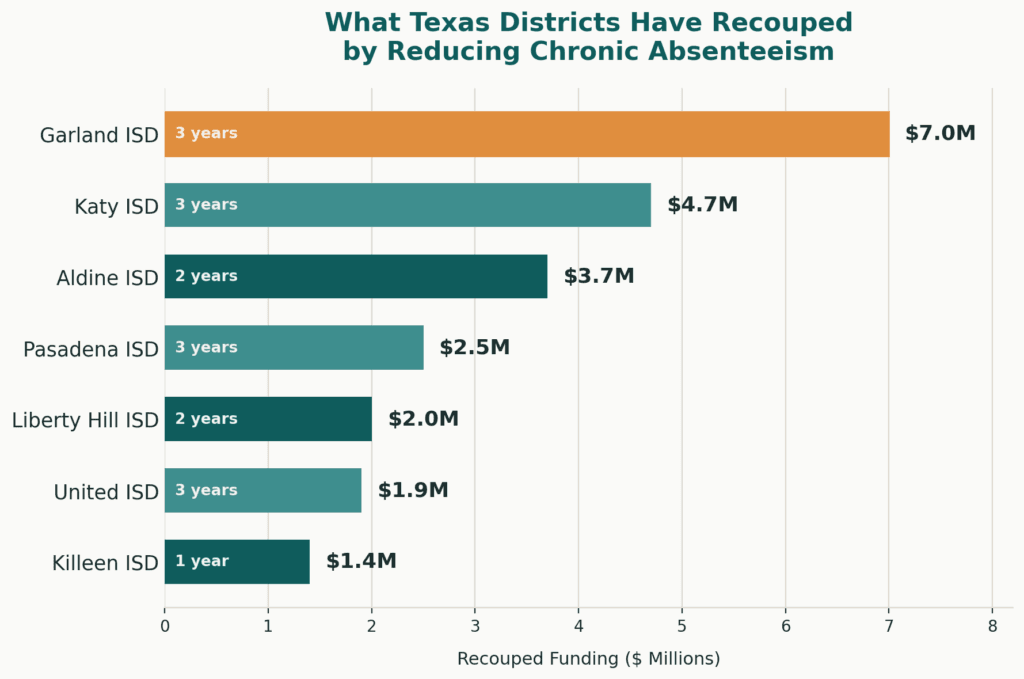
For any district weighing where to invest limited staff time, that’s a hard number to ignore.
From Reactive Conversations to Proactive Ownership
Chronic absenteeism impacts Attendance, Behavior, and Coursework together, meaning the ripple effects show up long before anyone notices a formal intervention is needed. The work of increasing attendance is everybody’s business, not the responsibility of a single office reacting after the fact.
Getting there requires systems, alignment, and shared ownership, not just a well-meaning point person. Building that shared ownership starts with forming the right team.
Building a High-Impact Attendance Team
A functional attendance team starts long before anyone gets assigned a task. It starts with agreeing on how attendance team will operate and who is responsible for what.
Set the Tone with Team Norms
Before assigning a single role, effective teams establish touchstones, shared group agreements that set expectations for how the team operates. Some agreements will resonate more than others depending on district context, and some should be treated as non-negotiable. Recurring themes worth building into any team’s norms include:
-
- Active enrollment and engagement from every member, not passive attendance at meetings
- Drawing on a variety of data sources rather than a single metric
- Staying open to novel solutions instead of defaulting to what’s always been done
- Leading with compassion and kindness, especially with families facing complex barriers
Skipping this step is a common mistake. Attendance teams that jump straight to task assignments without agreeing on how they’ll work together tend to fracture the first time a disagreement comes up.
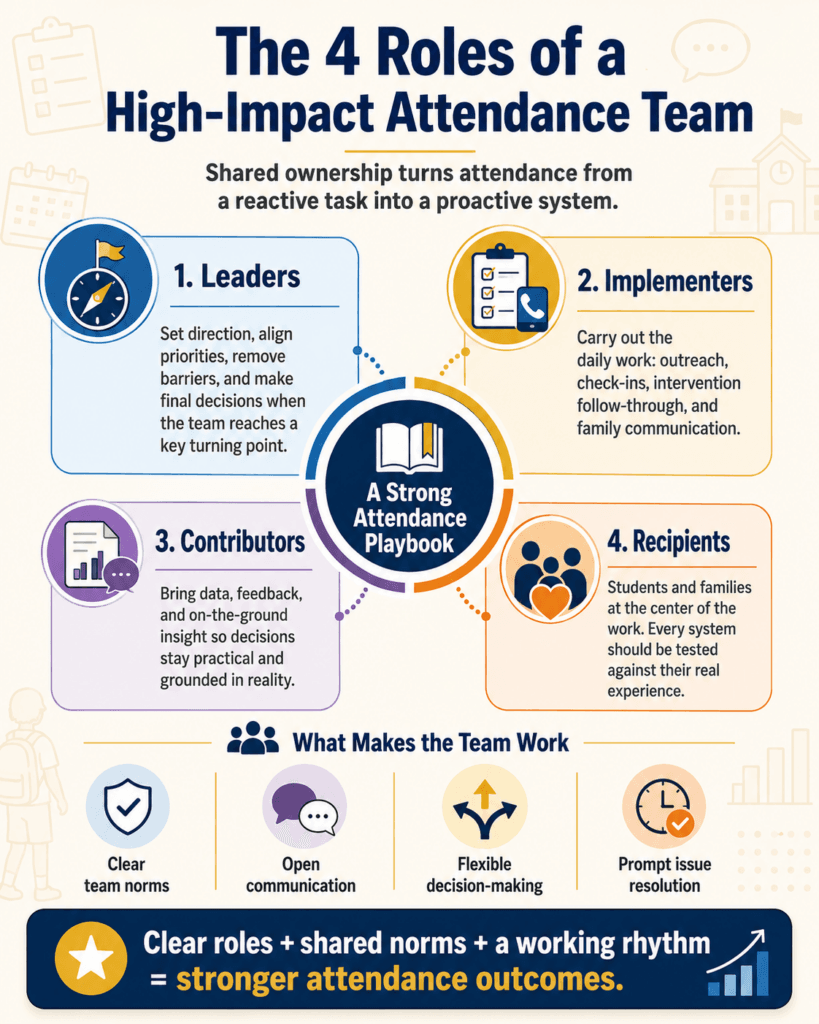
Define Four Roles, Not Just Job Titles
A strong attendance team framework fits any group, regardless of the titles already on your org chart:
Make Meetings Actually Work
A team is only as strong as its meetings. Come prepared with the right data and tools, respect people’s time, and stay focused on outcomes and next steps rather than open-ended discussion. A team function flowchart that maps how issues move from identification to resolution gives meetings a clear operating rhythm, rather than starting from scratch every time.
Where to Start This Week
Three exercises make the fastest starting point for any district building this foundation:
- Team Composition and Roles. Map out who fills each of the four roles on your attendance team.
- Foundational Work. Capture your team’s touchstones and non-negotiables.
- Team Functions Flowchart. Define how your team moves from data to decision to follow through.
A clear team, clear norms, and a clear operating rhythm are what turn attendance from everyone’s afterthought into everyone’s responsibility. That shift is what makes every strategy built on top of it actually stick.
Additional Resources
- Download the Definitive Guide to Student Attendance Improvement
- Download the Implementation Templates

About the Presenter
Sharon Bradley is a national educational consultant, author, and speaker with over 25 years of experience in K–12 education. She previously served as a district administrator in the Dallas–Fort Worth area, leading districtwide efforts in truancy prevention and student engagement, and has held roles including student services director, high school principal, assistant principal, and dropout prevention coordinator.
She is the author of Chronic Absenteeism: Prevention and Intervention Strategies for Schools, Families, and Communities and Combating Chronic Absenteeism through Attendance Intervention Plans. Sharon is also a founding member of Attendance USA and was recognized as a 2024 “Leader to Learn From” by EducationWeek and the 2023 “Person of the Year” by the International Truancy and Dropout Prevention Association.
She currently serves as Partner Success Manager at RaaWee K12 Solutions, supporting districts with proven attendance and engagement strategies.