
"When teams prepare together, students return to a stronger support system"
Every June, the same thing happens in schools across the country. Staff is exhausted, the year’s attendance battles are behind them, and everyone needs a break from student problems. That break is earned. But in California’s highest-performing attendance districts, I’ve noticed it doesn’t last the whole summer, and that is exactly why those districts get the results they do.
The dedicated teams in these districts hold a continuous goal: reduce chronic absenteeism and improve next year’s attendance by reaching students before a problem becomes severe enough to derail their education. That goal requires planning and work that begins long before the new school year starts. It is the difference between an ounce of prevention and a pound of cure — and the costs of the cure, paid by students, families, and society, dwarf the price of the prevention.
A Model with a Fifty-Year Track Record
This isn’t a hunch or a pilot. The framework behind these teams — California’s School Attendance Review Board (SARB) process — has been refining attendance best practices since the state legislature created it in 1974, roughly five decades of field-tested experience in keeping students engaged and out of the juvenile justice system.
Within that framework, a handful of districts earn the prestigious Model SARB designation for proactive, non-punitive approaches that use data-driven, multi-tiered strategies to address the real barriers behind absences. Desert Sands Unified, Val Verde Unified, and Anaheim Elementary are among them — and Val Verde’s program, profiled below with two short videos from its own team, shows the model in action. What follows is what those model teams actually do in the months when other schools have closed the books on attendance and, just as important, why districts in any state can adopt the same playbook without waiting for a state mandate.
The Model: A Summer-to-Fall Plan
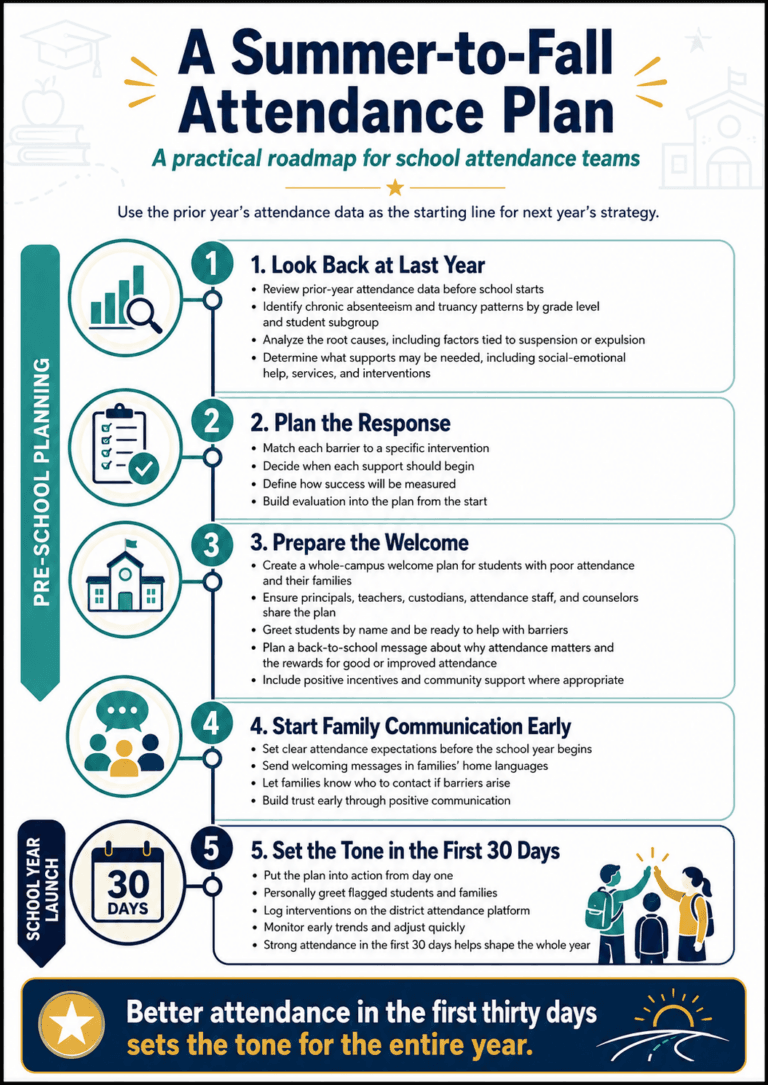
Consistently documenting outreach and interventions allows teams to monitor progress, avoid duplicated efforts, and quickly identify which students need additional support. The platform becomes the shared record that keeps everyone working from the same information.
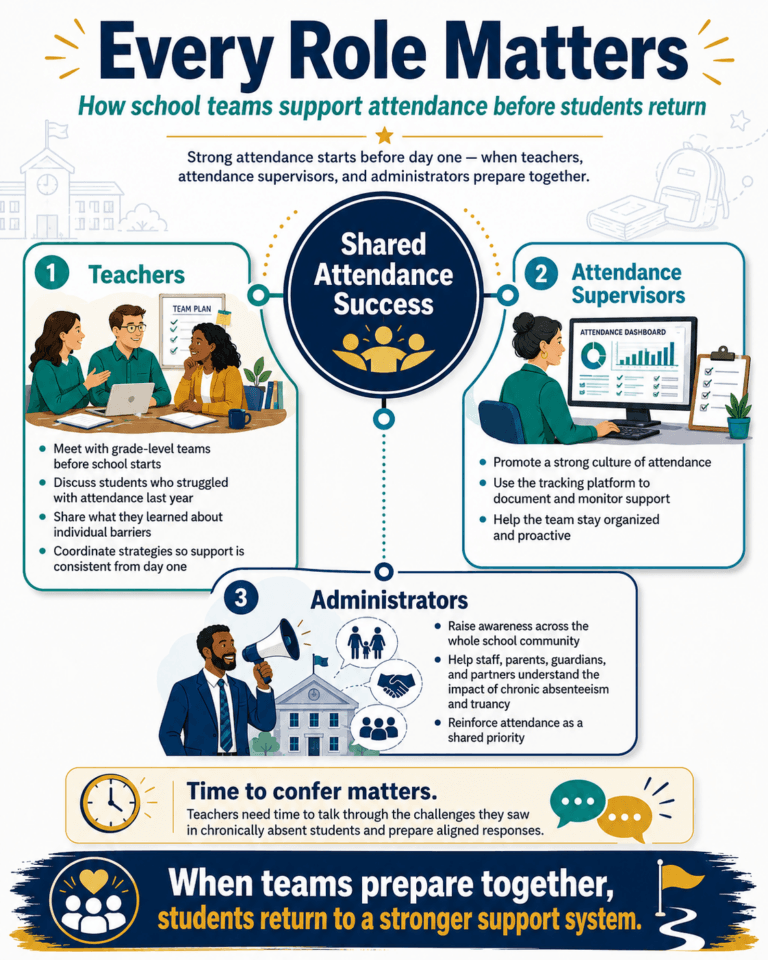
It is a lot of work before the year even begins. But the payoff — reduced chronic absenteeism, increased Average Daily Attendance funding, higher graduation rates, and more students prepared for life — far outweighs the cost of the planning, and outweighs by an even wider margin the price of doing nothing.
Proof in practice: Val Verde USD
Val Verde Unified School District, in Riverside County, shows what the model looks like when it runs for real. Serving roughly 20,000 K–12 students across Perris, Moreno Valley, and Riverside, Val Verde built a preventative SARB program staffed by five Teachers on Special Assignment whose job is to catch attendance problems early and remove the barriers behind them.
The district’s tiered triggers turn “look back early” into a concrete system. A Student Attendance Review Team (SART) meeting is convened as soon as a student reaches 5 absences in the first semester or 9 in the second; if attendance doesn’t improve, a SARB meeting follows at 8 and 13 absences. At each step, the team identifies the barrier early and tailors resources to that family’s situation — the same prevention-first logic the four phases above describe, operationalized with clear numbers. And like every model team, Val Verde reflects on its practices each year and adjusts.
Supporting that process requires tools that help staff stay organized without adding administrative burden.
“Over the past 11 years, our SARB program has concentrated on combating chronic absenteeism, and we are proud to have been recognized as a Model SARB recipient four times. Through our dedicated efforts, we have achieved a district-wide attendance rate of 96.7%, all accomplished without a district-wide transportation system.”
“We continue to work as a team to reflect on our practices each year and adjust as needed to ensure student success!”
— Madelyn Jackson, Attendance Specialist, Val Verde USD
Why does this travel beyond California
California built a statute around this work, but the statute is not what makes it work. The engine is the practice: looking at last year’s data over the summer, naming the barriers, assigning interventions, organizing a whole-staff welcome, and protecting the first thirty days. None of that requires a particular state’s law — it requires a team willing to start early.
A district in any state can adapt the model directly. Pull last year’s chronic-absence data and break it down by grade and subgroup. Convene a cross-role team — administrators, teachers, counselors, office and attendance staff — before the calendar fills up. Decide which barriers you will address, with which interventions, and how. Plan the welcome and the incentives. Then guard those opening weeks. States looking for a structural anchor can study California’s multi-tiered SARB model and the role of a child-welfare-and-attendance function; individual schools can simply borrow the four-phase rhythm and run it.
The lesson California’s fifty years offer the rest of the country is not “pass our law.” It is “do the prevention work in the summer, and do it as a team.“
Plug into the network
No team should build this alone, and the supports that have grown up around California’s model are open to colleagues everywhere — directly as members, or as a template other states can replicate.
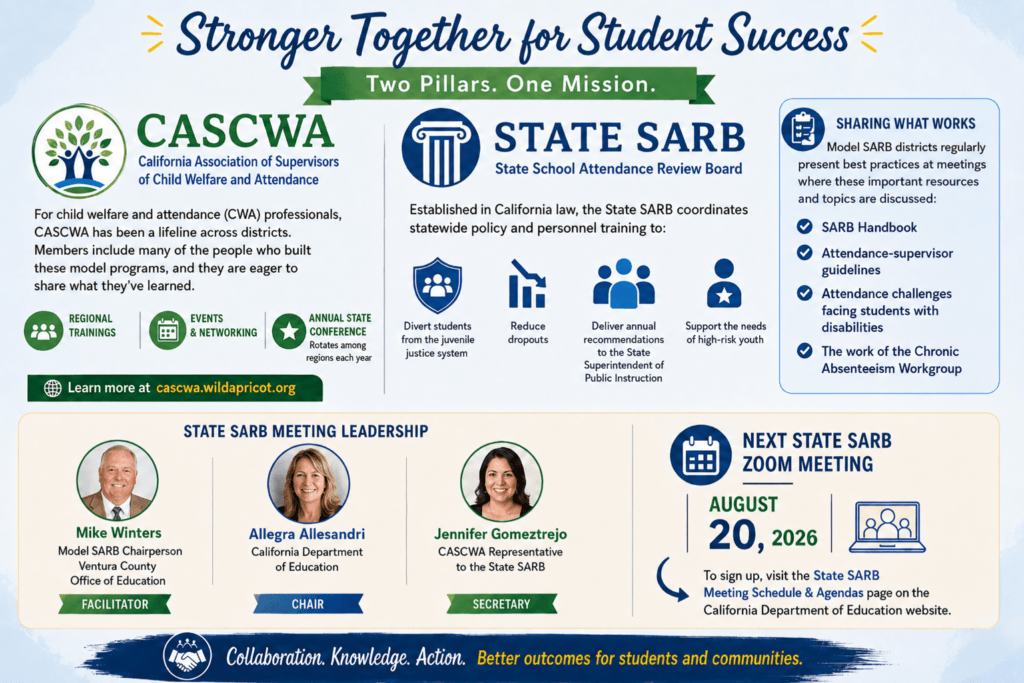
To sign up, visit the State SARB Meeting Schedule & Agendas page on the California Department of Education website: https://www.cde.ca.gov
For leaders in other states, these bodies are worth watching for a second reason: they are a working example of the statewide coordination, shared handbook, and peer network that make a prevention model durable. The practice can be borrowed today; the infrastructure can be built next.

About the Presenter
David Kopperud is a Veteran educator and former California state attendance leader with more than four decades of experience improving student attendance systems.
David brings over 41 years of experience in public education, with a career dedicated to improving attendance outcomes at the school, district, and state levels. His work began as a high school English teacher in California, where he first identified the direct connection between attendance and student achievement.
He went on to lead attendance improvement efforts as a district administrator and later served at the California Department of Education, overseeing statewide Child Welfare and Attendance programs. As Chair of the State School Attendance Review Board for 14 years, David helped shape attendance policy, professional learning, and legislative updates focused on reducing chronic absenteeism and dropout rates.
His expertise continues to inform results-based, multi-tiered attendance strategies that support students through coordinated, compassionate intervention.