
The Problem

Educators often find themselves strategizing how to get parents to become more engaged with their student’s school attendance and classroom activities.
 
And re-engaging students and families after COVID has further emphasized this concern.
HV1
When reminders, notification and warning letters to homes, ongoing phone call attempts, and now, emails and texts, fail to bring truant students back to school, what’s left? Attendance officers often find themselves traveling into neighborhoods/homes where they feel unwelcome and/or unsafe. Generating positive, mutually beneficial relationships in such a stressful situation is difficult (See Goff, 2016).
messy room

Advantages of Home Visits

Home visits by social workers or attendance/truancy officers are vital means to establish positive contact and communication with hard to reach parents and families. These visits are NOT considered alternatives for parent-teacher conferences in schools, instead, the visits create an environment where the families feel more comfortable.
The home visits show a sincere desire to facilitate and work with concerned families, as well as, promote proactive communications through which the school system may provide reliable support to the families and their students. Johnson (2014) termed home visits between schools and families as a means by which to negate “deeply entrenched institutionalized inequities” in the American educational system. He noted that since the lives of educators are often disconnected from the lives of their students, district home visits promote the type of relationships and social support that enhances the academic goals of students.  As well, he was of the view that by restructuring traditional family-educator communications and “blurring the boundaries between classrooms and living rooms,” home visits can positively impact the academic success of the students and reveal valuable educational resources in students’ homes (Johnson, 2014, p. 359).
 
On February 20, 2020, Wil Barbee, Lead Attendance Officer, and Angel Seca, Attendance Officer of Abilene Independent School District (ISD) in Abilene, TX shared Best Practices in Conducting Safe Home Visits at the Every Day Matters Summit.

About Abilene ISD

Abilene ISD Attendance Officers share the belief that home visits are a critical intervention in their toolkit for the most resistant truants and hard-to-reach guardians.
Abilene ISD, TX logo
They are also very realistic in the difficult situations that their officers often walk into. Their best practices for conducting the essential home visits are designed to be productive, efficient and ensure the safety of their eight team members.
 
Abilene ISD consists of 33 schools serving 16,600 students. AISD consists of 44% Hispanic, 37% Anglo, 13% African American, 4% two or more races, and 2% Asian/Pacific Islander. Nearly 70% of students are economically disadvantaged. The Annual Attendance Goal is 97%. 
 

For both efficient and safe home visits, this experienced and dedicated team breaks the intervention into three stages: 1) PreVisit, 2) On Location, and 3) Departure

 
The PreVisit recommendations include making sure you: have planned time and location, are dressed appropriately, have everything you need and nothing valuable that is unnecessary, and a reliable and readied vehicle. 
No heels
Dress appropriately in a professional business manner with special attention to appropriate closed-toe, lower-heeled shoes, and clothes that do not hamper movement and departure.

Plan your trip using a reliable mapping program for arrival and departure in daylight hours, and ensure you have knowledge of the area/neighborhood concerns. Assure the vehicle you are taking is in good working order and has adequate fuel.

RaaWee Attendance+ includes a Mobile App with a powerful feature that assists with this route mapping.


When ready to leave for the Home Visit, let someone know where you are going or take someone with you. Double-check that you have your ID and all the documents you need ready and easily accessible.
 
Avoid taking valuables with you or leaving them visible in your parked car. If necessary, hide or lock them in the trunk prior to arriving at home visit site. Keep cell phone or RaaWee Attendance+ iApp with you – ready for recording, pictures or emergency calls as allowed by law. 
ID Card

The application of this OODA Loop methodology is strongly recommended for all Home Visits.

Use the following practical application. Upon arrival prior to parking, drive by the home. If it looks unsafe, do not proceed with the home visit. Document the situation. When proceeding with the home visit, park selectively. Do not block anyone’s parking or driveway. Park in an area that will be easy to exit.

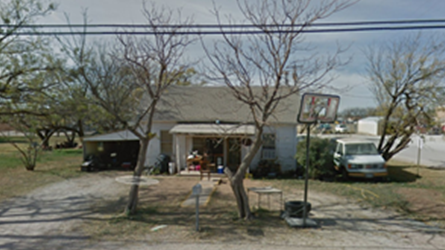
When approaching the home, check for other dangers such as pets, high fences or other obstacles, as well as people in or around the home.
Always avoid going inside the home. Conduct your business in a professional but timely manner from the porch or entry.
Home visits
Remain aware until AFTER Departure. Exit and leave the house as soon as possible. Document your visit once in a safe and highly visible area away from the home. Do not write notes or get on the phone in your parked car. 
 
And finally, let someone know you are back on campus or have completed the home visit, especially if you are not driving directly back to campus.
 

Conclusion

Teachers, parents, and policymakers share the responsibility to ensure that K-12 students achieve academic excellence at the highest possible level at the Abilene ISD. In all of this, developing strong parent-teacher partnerships is vital and may require a structured home visit. Home visits can play a vital role in the promotion of excellent academic results and behavior of the students. When needed, be prepared, be aware, be quick, and stay safe!
 

References

Goff, P. A. (2016, September 1). Addressing Classroom Bias to Improve Learning. In Schott Foundation Webinar Series.
Johnson, E. J. (2014). From the Classroom to the Living Room: Eroding Academic Inequities through Home Visits. Journal of School Leadership, 24, 357–385.

Involving Campus & Community

On a broad scale, it is well accepted that community engagement is critical for school progress and reform and Strategies for Community Engagement in School Turnaround (School Network Reform, 2014) provides us best practices. Attendance Works shows how important it is to Engage Community Stakeholders in Promoting Attendance and provides inspiring examples specific to Attendance Awareness. 

Involving campuses and community for student incentives that work

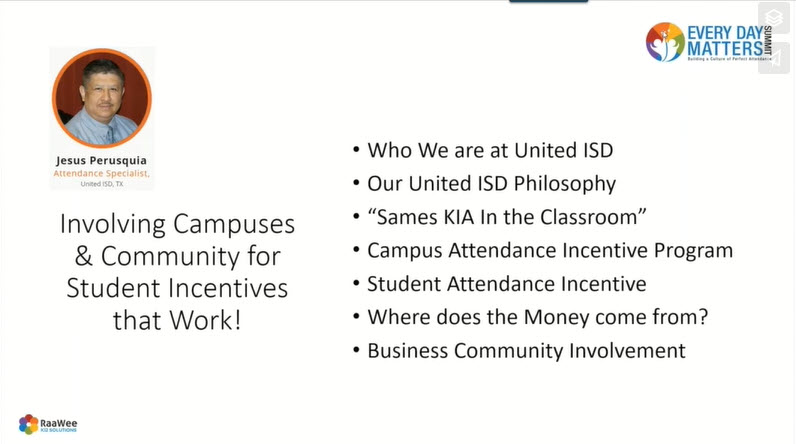
We add the United Independent School District (UISD) to those districts worth replicating. UISD shares its successful programs with education leaders at the RaaWee Every Day Matters Summit, November 15, 2019. View this entire best practices session at Involving Campuses & Community for Student Incentives that Work at United ISD – Every Day Matters Summit 11.15.2019.

About UISD

United Independent School District in Laredo, TX – serving the cities of Laredo, El Cenizo and Rio Bravo, and various discrete regions in Webb County – has built a comprehensive program set that draws benefits and success from both by highly engaging the community in the pizza, donuts, and ice cream parties or other “treat-like incentives,” as well as other larger prize opportunities for long-term attendance goals. 

United ISD

This allows local business leaders to play an active role in the success of their future employees and customers and students to build relationships and confidence outside the classroom.

Developing Attendance Awareness

In support of the fundamental premise that the success of their students is highly dependent on each student’s daily school attendance, UISD has built a powerful model for engaging their community in scalable programs that provide fun incentives for classrooms at all campuses and meaningful grade-appropriate recognition, starting in the early grades and continuing through a power prize opportunity for those students who have met the attendance requirements up to graduation day. The overall program set does a wonderful job of tying short-term rewards and recognition (building good attendance habits early) to long-term opportunities. Their Every Day CountsNever Be Absent, and Kia in the Klassroom programs are examples of this.

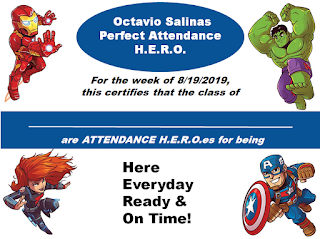
Attendance Hero

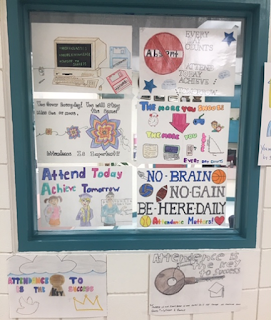
With Every Day Counts, UISD elementary and middle school students, strive to attain perfect attendance by classroom in each of the district’s six week grading periods, making them eligible to win fun prizes at their respective campuses. Awareness for these is built with posters, many made by the students, and rewarded with treats sponsored by local businesses. Check out these examples.

Individual classrooms and students attaining perfect attendance – no excused or unexcused absences up to that point in all classes – at UISD elementary or middle school receive Recognition Certificates and are eligible for the grand prize drawings at their campus. These include:

  • 1st Six Weeks: 4 bikes per campus (Elem/Middle)
  • 2nd & 6th Six Weeks: ChromeBook (Elem/Middle)
  • 3rd & 5th Six Weeks: X-box (Elem/Middle)
  • 4th Six Weeks: 4 bikes per Campus (Elem), Beats Solo Wireless Headphones (Middle)
school board

High school students at UISD qualify for additional perfect attendance incentives, under the Never Be Absent program. Students who have maintained perfect attendance have a chance to be their high school’s winner of an all-expense-paid weekend getaway for a family of four to JW Marriott San Antonio Hill Country Resort & Spa with season passes to Fiesta Texas and movie passes to Santikos Palladium IMAX. 

Special Year-End Attendance Program

The prestigious year-end Sames Kia in the Klassroom program provides one lucky high school student who wins a drawing with a brand new Kia Soul car. Students earn drawing chances by maintaining perfect attendance in each 9-week period. Students can earn up to 4 vouchers/chances at the end of the school year drawing. The Sames Kia in the Klassroom car give-a-way program is made real by the long-time sponsorship of the local Sames Kia Dealership. And to add amazing additional value, Laredo Federal Credit Union pays taxes & license fees and A&K Driving School includes their driving course to complete this comprehensive package for this lucky student with perfect attendance.

Attend school every day

Funding The Programs

The key question “How are these programs funded?” arises immediately. For UISD, the answer is by engaging the community, a community that eagerly participates because they understand the importance. Asking for participation and donation – small and large – is a regular activity for UISD. Check out this example of a typical request, they have recently used. This Donation Request Letter represents key elements recommended in two great resources for writing your own – How to Write an Efficient Donation Request Letter – A Research Guide or How-To Write a Donation Request Letter.

For more information on these programs and all that United Independent School District does to reach and maintain their Attendance Goals for each student district-wide, check out our Every Day Matter Summit presentation by Jesse Perusquia Jr., Attendance Specialist for UISD.

Jesus Perusquia

About the Presenter

Jesse Perusquia Jr., Attendance Specialist, United ISD, TX

Jesse Perusquia Jr. is an Attendance Specialist at United Independent School District (UISD), where he is dedicated to promoting student attendance and engagement. With a focus on fostering positive relationships between students, families, and the school community, Jesse works diligently to implement strategies that improve attendance rates and support student success.

In his role, Jesse collaborates with educators and administrators to identify challenges affecting attendance and develop effective interventions. His commitment to creating a supportive educational environment helps ensure that all students have the opportunity to thrive.

For inquiries, Jesse can be reached at 956-473-6281 or via email at jperusquia@uisd.net.

Attendance Awareness Communications

How to Use Social Media to Improve District Communications (Finalsite.com, 2018) tells us that “Social media has quickly earned itself at the top of the list for necessary communication tools … to improve their school-to-home communications.” The attendance improvement best practices and strategies they share for each social network are valuable for those districts just getting started and existing district users alike. These recommendations include which types of social media are better at reaching which audiences. 

Beaumont USD, CA logo

About Beaumont USD

Beaumont Unified School District (BUSD) does a great job in their use of social media, and their activities reflect real-time examples of these recommendations. Beaumont USD is situated in the San Gorgonio Pass, in Riverside County, California within a growing city of nearly 45,000 residents. BUSD operates seven elementary, two middle, and two high schools and serves 10,829 K-12 students and their families.

Beaumont USD shared its district strategies, including the successful social media outreach at the RaaWee Every Day Matters Summit, on November 15, 2019. View the entire event at Applying the “Mind in Boat” Teamwork & Focus to Attendance Improvement at Beaumont USD – Every Day Matters Summit 11.15.2019.

Beaumont USD uses Social Media for Successful Outreach

BUSD has applied a comprehensive communication social media strategy to improve the attendance at their schools. Through these tools, they share the great things happening at Beaumont USD on a daily basis. And it serves as cornerstone media in their attendance awareness campaigns. 
The social media tools narrate student success stories, employee recognitions and achievements, parent resources, school programs, services, and various opportunities, school board policies, and conventions; these are subjects of great interest that it shares with its community.
 
District and Community News are communicated through a variety means that include the BUSD website and social media accounts.
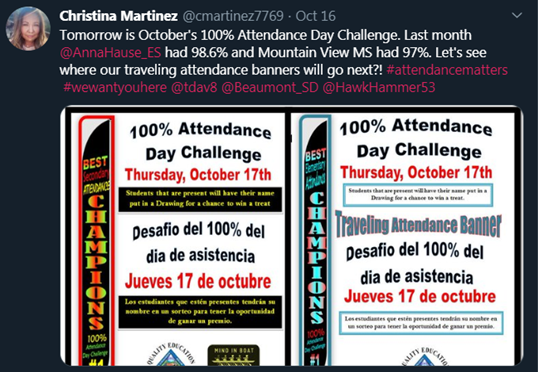
Attendance Day Challenge
The District social media accounts include both district-wide Facebook – BeaumontUSD – and Twitter – @Beaumont_SD – accounts. They also make use of Parent Square and Peach Jar which are their School-Home communication platforms. 
 
Although BUSD does not use Instagram, Snapchat or other accounts, these are also great opportunities to reach specific groups within the community. Check out best practice detail as previously referenced in How to Use Social Media to Improve District Communications (Finalsite.com, 2018) for additional ideas on audience-specific outreach.

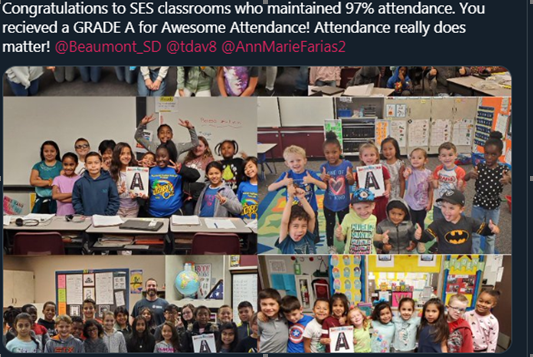
They found that both Facebook and Twitter serve them well, but in different ways. They have more parents on their Facebook account and they find that the parents share the flyers and other information amongst one another. Twitter is great because the staff and school sites share their progress, awards, trophies, etc. Everyone appreciates visible recognition.

SES Classrooms
Weekly Bulletin Starlight Elementary

Consistent Meaningful Attendance Content is Key

The District creates an annual calendar with the contributions of parents, teachers, classified workers and administrators who serve on a calendar committee and use organized community meetings to solicit and incorporate user feedback. 
The posted content comes from flyers and other print materials that are provided to the BUSD Communications Officer for posting in both English and Spanish. Don’t forget the importance of addressing community diversity when reaching out using these newer media.
And a final best practice from the Beaumont USD team is the consistency in their social media use. They are committed to and consistent in keeping these accounts are up-to-date and the place to look for information. This keeps everyone involved and communications successful.
BUSD

For more information on Beaumont Unified  School District and all they are doing to reach and maintain their Attendance Goals for each student district-wide, check out our Every Day Matter Summit presentation by Christina Martinez at BUSD.

The Longstanding Problem of Chronic Absenteeism

Since the start of compulsory education in the US, absenteeism has been a problem, one that educators recognize as among the most persistent and critical challenges schools experience in the country (Gottfried & Hutt, 2019). However, it was not until 2016 that the US Department of Education published a report that created awareness of chronic absenteeism as a critical issue (U.S. Department of Education, 2016)

All over the US, over 8 million students are chronically absent from schools and hence are academically at-risk. Chronic absence implies missing 10 percent or more of school days by students due to excused, unexcused absences and suspensions, and transformed themselves into third-graders who are unable to master reading; the sixth-graders failing in subjects and the ninth-graders dropping out from high schools. Research has shown that chronic absenteeism can impact academic performance in later grades and is a key early warning sign that the students are more likely to drop out of high school (Balfanz & Byrnes, 2012).

Detailing California’s Approach

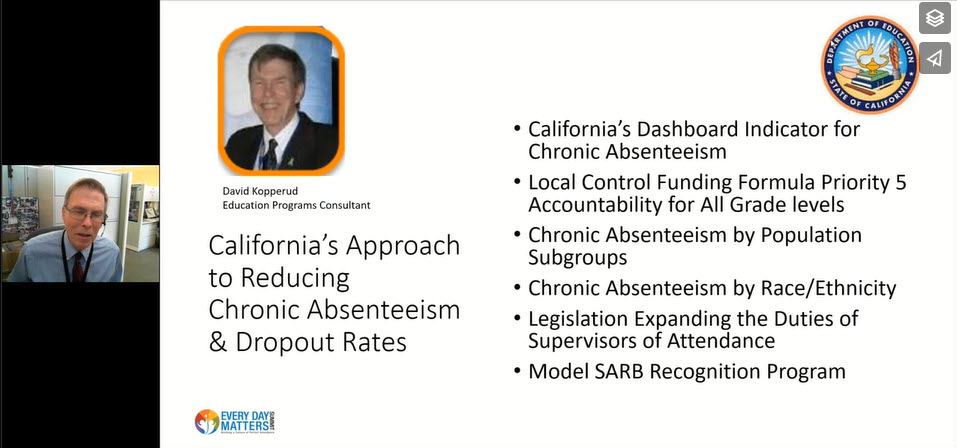
The RaaWee EVERY DAY MATTERS SUMMIT, February 20, 2020, welcomed David Kopperud, Education Program Consultant at the CA Department of Education for a discussion of California’s Approach to Reducing Chronic Absenteeism & Dropout RatesAt this event, he shared the California strategies with 100 education leaders from more than 50 public school districts nationwide. View the entire conversation at California’s Approach to Reducing Chronic Absenteeism & Dropout Rates – Every Day Matters Summit – 2.20.2020

California's Approach to reducing chronic absenteeism
Watch Video Event

According to David Kopperud on chronic absenteeism, “You have kids with health problems and mental health problems; you have young children who are missing school for no fault of their own.” He further stated: Schools with high poverty levels tend to have higher rates of chronic absenteeism, and “one of the best ways we can address poverty is by figuring out what can we do to help these students get to school despite lack of transportation, health issues, trauma, and anxiety.”

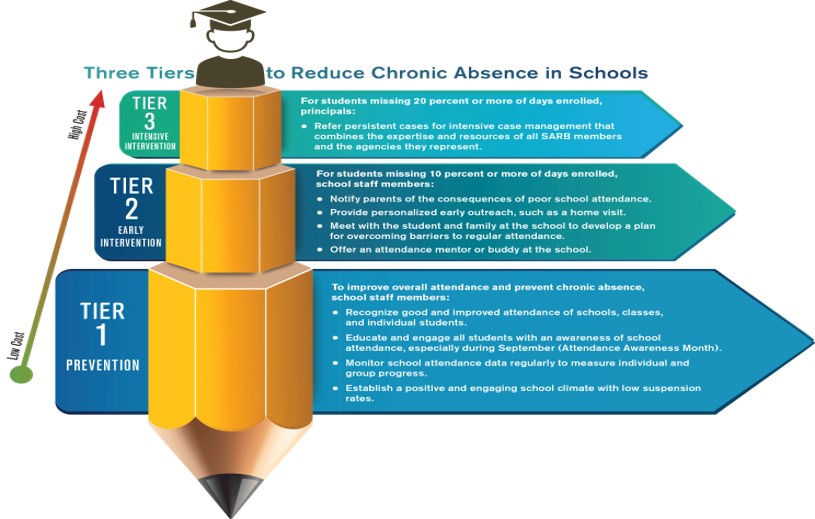
The data released by education officials in California in 2017 showed that 10% of students in the state were chronically absent. As a result of the findings, California dramatically shifted its approach to school-absence away from punishing absenteeism, or unexcused absences, towards the identification of the rationales for all absences and offering support. This approach has been defined in a three-tier strategy for Prevention, Early Intervention, and Intensive Intervention.

The data also shows that 25% of foster children were chronically absent in the same year, in addition20% of students were of Native Americans and African-American origin. Mr. Kopperud emphasized their obvious need to monitor and address chronic absenteeism by Sub-Group, using more targeted services and resources. 

Three Tiers (MTSS) to Reduce Chronic Absenteeism in California

3 tiers to reduce chronic absence in schools
 
  • Prevention – Tier 1 focuses on ongoing Recognition/Reinforcement, broad Awareness, diligent Monitoring, and positive welcoming School Climate. It is intended to improve overall attendance and prevent chronic absence. 
  • Early Intervention – Tier 2, designed to address the needs of students missing 10% or more of school days, begin notifications, meetings, and services to students and guardians.
  • Missing 20% or more of school days triggers Intensive Intervention – Tier 3. These interventions target repeat offenders with the expertise, services, and resources of all SARB collaborative stakeholders and their respective agencies. 

Check out more information on California’s approach to: 

California SARB (School Attendance Review Board)

The School Attendance Review Board (SARB) is key to the California approach to reducing chronic absenteeism. Mandated by legislation, SARBs are comprised of stakeholders representing the various district and community services and resources for the chronically absent student and their family. School Attendance Review Board Handbook provides additional detail.

In California, SARBs are district-level teams that are composed of school and community members who meet regularly to diagnose and resolve persistent school attendance or behavior problems. The Model SARB Program identifies outstanding results-based school attendance improvement programs that provide comprehensive services to high-risk youth with school attendance or school behavior problems.

The State SARB makes recommendations to the State Superintendent for reducing chronic absenteeism rates and dropout rates in the state’s public schools. As part of its mandate, the State SARB makes annual recommendations regarding the needs of high-risk youth. The most recent recommendations include the following four improvements:

  1. Develop Local Control Accountability Plan (LCAP) strategies for Groups with higher Chronic Absenteeism rates – again emphasizing the unique needs and resources by Sub-Group.
  2. Mandate small districts to obtain certification for their supervisors of attendance. This has not been previously required of smaller districts with personnel often “wearing many hats” within their district but has proven necessary for broader success.
  3. Mandate kindergarten attendance starting at enrollment.
  4. Advocate for the inclusion of grades 9-12 on the California School Dashboard, which is currently focused on elementary and middle grades.

The California Model SARB Recognition Program identifies and recognizes innovative results-based school attendance improvement programs at different levels. The programs serve as models for other SARBs across the state of California. The goal of California SARB is to reduce chronic absenteeism rate by 1% annually. Get full detail on the California Model SARB Recognition Program.

CADOE
David Kopperud Education Programs Consultant, CDE

About the Presenter

As the education programs consultant for Child Welfare and Attendance at California Department of Education (CDE), David Kopperud is the chairperson of the State School Attendance Review Board (State SARB) and the director of the CDE’s Model SARB Recognition Program.

A former English teacher, he first became interested in child welfare and attendance after noticing a large number of students who were not attending his classes. After working as coordinator of Child Welfare and Attendance in the Hemet Unified School District, he served as Child Welfare and Attendance Administrator and Director of Personnel and Pupil Services at Washington Unified School District before coming to work at the CDE.

David Kopperud, Education Programs Consultant
California Dept of Education
916.323.1028
cwa@cde.ca.gov

References

Balfanz, R., & Byrnes, V. (2012). Chronic Absenteeism: Summarizing What We Know From Nationally Available Data. Baltimore; Johns Hopkins University Center for Social Organization of Schools), 9. http://new.every1graduates.org/wp-content/uploads/2012/05/FINALChronicAbsenteeismReport_May16.pdf 

Gottfried, M.A., & Hutt, E.L. (Eds.) (2019). Introduction to Absent from School: Understanding and Addressing Student Absenteeism. Cambridge, MA: Harvard Education Press. https://www.hepg.org/hep-home/books/absent-from-school

U.S. Department of Education (2016). Chronic Absenteeism in the Nation’s Schools: A Hidden Educational Crisis. Washington, DC. https://www2.ed.gov/datastory/chronicabsenteeism.html