Description

Alicia Bradley, Director of Student Services at Duncanville ISD, shared two flexible attendance models that boosted ADA funding and student success. RaaWee K12 Solutions supports such innovations with data-driven tools that streamline attendance tracking, helping districts like Duncanville implement effective, flexible programs for at-risk and dual credit students.

Flexible Models to Maximize Instructional Minutes

Duncanville ISD is implementing innovative attendance strategies to better support student success and improve Average Daily Attendance (ADA) funding. Through the Optional Flexible School Day Program (OFSDP), at-risk students can earn attendance with just 45 minutes of daily instruction. In the 2023–2024 school year, six students participated, resulting in a 3% ADA increase from 70% to 73%.

A second approach, the dual credit flexible day model, uses a state-approved waiver to allow 11th and 12th graders enrolled in Dallas College to receive full ADA funding without traditional attendance requirements, preserving instructional quality while respecting students’ academic commitments.

Data-Driven Attendance Solutions

These models were designed in response to attendance trends identified through continuous monitoring, such as seasonal declines at Duncanville Collegiate High School and fluctuations at Pace High School. The OFSDP personalizes instruction through designated flex days, while the dual credit model aligns with state compliance without disrupting college coursework.

Enhancing Accuracy with Smart Tools

Accurate documentation is essential for both compliance and funding. RaaWee Attendance+ supports these initiatives by offering robust tools to track instructional minutes, analyze attendance patterns, and generate reports. As Duncanville ISD continues refining its strategies, smart solutions like RaaWee play a key role in linking academic success to sustainable attendance practices.

About the Presenter

Alicia Bradley, Director of Student Services at Duncanville ISD, TX

Alicia Bradley serves as the Director of Student Services for Duncanville Independent School District (ISD), where she leads a department dedicated to supporting the academic and personal success of students. Under her leadership, the Student Services Department coordinates essential programs and services, including attendance and truancy management, enrollment, residency verification, student transfers, and support for students in foster care or experiencing homelessness. The department also assists with legal and custodial matters, ensuring that all students have access to the resources they need to thrive.


Amir Alavi with Katy Wood discussed shifting SARB from punitive to restorative, using empathy and tailored support. Katy introduced a restorative SART contract that focuses on empathy, understanding family barriers, and providing tailored support. The district expanded attendance teams and uses restorative language. RaaWee truancy prevention software streamlines this process by auto-filling contract data, saving staff time.

Reframing the SARB Process Through a Restorative Lens

Katy and Amir introduced a restorative lens to the traditional SARB process, advocating for a shift from punitive enforcement to empathetic engagement. Using the case of “John Doe,” a hypothetical seventh-grade student navigating ADD, family instability, and trauma, they illustrated how court threats and truancy warnings often compound disengagement rather than solve it.

Building Trust Through Restorative SART Contracts

To foster trust and build bridges, Katy shared a restorative SART contract that helps uncover family challenges through thoughtful dialogue. It includes structured prompts for background context, discussion, and barrier identification; guiding teams toward individualized, supportive interventions. Restorative language and parental partnership were highlighted as essential in creating a safe space for families.

Strengthening Support with Attendance Teams and Technology

The district has bolstered its support infrastructure by deploying attendance teams across school sites, ensuring deeper connection and continuity. RaaWee’s truancy prevention platform complements these restorative efforts by integrating tools like the SART contract into its system. Beyond automation, it enables staff to spend less time on paperwork and more time building the relationships that drive long-term student engagement.

About the Presenter

Amir Alavi, MA JD, Director of Chronic Absenteeism Reduction, Riverside County Office of Education;.

Amir Alavi is a seasoned criminal defense attorney in Riverside County, California, with over a decade of experience as a Deputy District Attorney. He has handled thousands of cases, giving him deep insight into both prosecution and defense strategies. Now leading Alavi Law, he focuses on criminal defense, DUI, and vehicular offenses. Known for his client-centered approach, Alavi combines strong advocacy with a commitment to helping clients make lasting, positive life changes.

Co-Presenter

Katy Wood, MS, NCSP, LEP #3926, Coordinator – Student Support, Attendance & Section 504, Murrieta Valley Unified School DistrictCo-

Significant Strides

Aldine ISD is making significant strides in tackling chronic absenteeism and addressing attendance improvement with a clear strategy rooted in data, structure, and support. With nearly 60,000 students, the district improved its average daily attendance (ADA) by over 1% in just one year, translating into more than $6 million in regained funding and reduced chronic absenteeism from 33.3% to 26.3%. 

At the heart of this progress is a focused approach to identifying barriers and delivering personalized interventions, prioritizing students, empowering campuses, and leveraging the right tools.

Structure First: Clear Roles, Shared Ownership

Aldine ISD started by fixing internal gaps. Each attendance role; administrators, assistant principals, clerks, and registrars was clearly defined. This created shared ownership across the system. Weekly check-ins and meetings ensured regular updates on interventions and student progress.

Real-Time Data Drives Smarter Student Supports

Instead of guessing, Aldine ISD uses real-time data to guide decisions. Through RaaWee Attendance+, the district tracks patterns and monitors interventions at both student and campus levels.

This tool highlights areas needing attention and reveals trends. District leaders can then focus resources where they matter most. Weekly reports sent to principals and assistant principals keep everyone aligned and ready to act.

Tiered Support for Targeted Impact

Support isn’t one-size-fits-all. Campuses are tiered based on attendance data. These tiers adjust during the year, depending on performance and need. Each tier comes with clear resources and guidance, creating a supportive not punitive system.

Students in the “yellow” group, who are beginning to slip, get special attention. By stepping in early, the district helps prevent chronic absenteeism.

Strategic Outreach for Student Re-Engagement

Barriers often go beyond school. That’s why the district uses layered outreach. First come calls and texts. If needed, home visits follow. These visits help reconnect families and uncover deeper needs, like relocation or additional support.

Encouragement Through Positive Reinforcement

To keep students engaged, each campus gets a small incentive budget. These funds are used creatively; treats, school supplies, event invites to reward attendance improvements. This builds a culture that values and celebrates showing up.

Equity-Driven, Action-Oriented Approach

Aldine ISD’s model shows that real change comes from systems, data, and people working together. Tools like RaaWee make it easier to spot problems early and act quickly.

By focusing on the right students at the right time, the district delivers support where it’s needed most. This targeted, data-driven approach ensures every resource makes a difference, especially for those most at risk.

Proactive Absenteeism Prevention

Dr. Caroline Gentle-Genitty emphasized proactive absenteeism prevention by tracking attendance, participation, and social factors. She highlighted RaaWee Attendance+ as an exemplary tool for comprehensive data and response. She advocated for integrated systems, prosocial relationships, and policy changes, stressing external influences like sleep and food security in improving attendance.

Understanding Attendance Beyond the Classroom

Dr. Gentle-Genitty highlighting the importance of addressing both in-school and out-of-school factors that contribute to absenteeism. Beyond attendance tracking, she highlighted the role of sleep quality, food security, and home environment in student engagement.

Data-Driven Insights for Intervention

Integrated data systems are key to understanding student behavior. Gentle-Genitty advocated for comprehensive tracking of attendance, participation, and social bonding to provide a holistic view of student experiences. She underscored the importance of direct and indirect control, such as incentives and prosocial relationships, in improving attendance.

Leveraging RaaWee Attendance+ for Monitoring

As an early contributor to RaaWee Attendance+, Gentle-Genitty highlighted its ability to identify attendance barriers and support interventions. The platform integrates multiple data points, allowing educators to make informed decisions that target the root causes of absenteeism.

Collaboration for Long-Term Impact

Successful attendance strategies require cooperation between schools, families, and communities. Action items included revisiting tardy policies, leveraging data for targeted interventions, and continuously reviewing research to refine attendance initiatives.

Shaping Policy for Sustainable Change

Gentle-Genitty stressed the need for policy adjustments and ongoing evaluation to ensure schools are effectively addressing absenteeism. By integrating data, collaboration, and proactive strategies, schools can create lasting improvements in student attendance.

About the Presenter

Dr. Carolyn Gentle-Genitty, founder, lead consultant, and Chief Education Officer for Pivot Attendance Solutions, TX

She has inspired many administrators, educators, students, and school social workers as a past chair of the school’s concentration Masters Curriculum, tenured professor, and Director of the Bachelors for Social Work Program. Having worked closely with Indiana Department of Education to assist school counselors in acquiring a school counselor license and coordinating curriculum mapping and application, she knows the intricacies of working with school-community partnerships. She has been a forerunner in responding to school absenteeism, truancy, and social bonding. She has over 30 years in youth development, 20 years in dropout and truancy and more specifically she brings over 12 years studying, researching, presenting, and writing about absenteeism locally, nationally, and internationally.

In the US she is a leader in absenteeism and understanding school attendance problems and translating such into practice models for implementation. She is forging partnerships in colleges to establish the area as a formal field of study.

Proactive Strategies

Take a break from the hamster wheel. Plan your year! Assess why you do what you do and the results you are getting. Intentionally defining and planning to prevent absenteeism requires methods and tools, partnerships and data interpretation, and social connections. The result of these factors lends itself to the content necessary to identify needed messaging strategies and influence change for measurable positive attendance improvement outcomes. 

from EDMS Expert Series: 09/22/2022

Discussions in Preventing Absenteeism

Discussions of the importance of schooling and student attendance dates far back to 1635, in Boston. It was similar to the Free Grammar School of England. The Boston Latin School for boys was introduced to prepare students for college, although some like Benjamin Franklin dropped out (See here). Since then and now, there have been questions about how to prevent children from leaving or missing school. The study of school absenteeism, now being advanced worldwide by the International Network for School Attendance (INSA) and supported by various national organizations, is documenting scholarly research on forms, types, categories, and methods to examine school attendance and absenteeism. In fact, their earliest citation dates back to the 1980s with the first accessible article by Berney, Kolvin, Bhate, Garside, Jeans, Kay, & Scarth (1981) on school phobia in the British Journal of Psychiatry.

The point is, we have been studying, examining, and trying to figure out how to prevent student absenteeism for centuries. With mountains of data, processes, ways, and means to approach at least one answer we have come to know that methods, tools, and messaging are the hallmark of any effective solution. Such solutions should be consistent and cyclical.

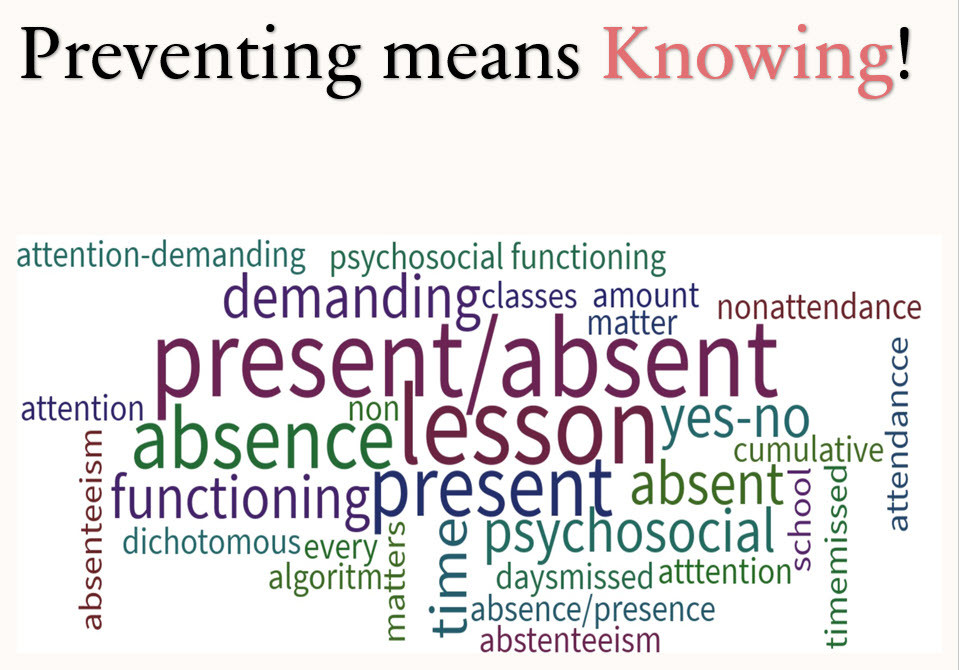
Accomplishing consistency in methods, tools, and messaging speculates, to prevent we must know.

Preventing means knowing

Preventing is knowing! 

We must know what we are preventing and what symptoms have been shown to indicate an interest in being absent or signals of willingness to be present. These can include psychosocial matters, home, academic, curriculum demands, functioning, time-based discipline, lesson absence, classroom climate, and more. Therefore, we should be asking “what matters?”

Absenteeism = All Experience

Knowing absenteeism equals the total sum of a students’ in-school and out-of-school experiences, then what matters is what happens in and out of school.

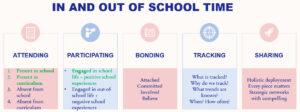
In and out of school means what matters for students regarding:

  • Attending – Presence and absence from school and curriculum
  • Participating – Engagement in or not in positive and negative school experiences
  • Bonding – Feeling attached, committed, involved, and believing in the value of school
  • Tracking – Who, what, and why track attendance and insights gleaned to improve
  • Sharing – Using information for benefit of students and shared for improvement for all
In and Out of School Time

Knowing what matters in and out school offers us the opportunity to learn also that control matters. There are three forms of Direct control (rewards and punishment), Indirect control (pro-social relationships), and Internal control (personal compass). Finding and implementing tools and interventions to respond to these three (3) forms of control are sure ways to prevent school absenteeism.

Getting to outcomes however, requires us to have methods, tools and messaging.

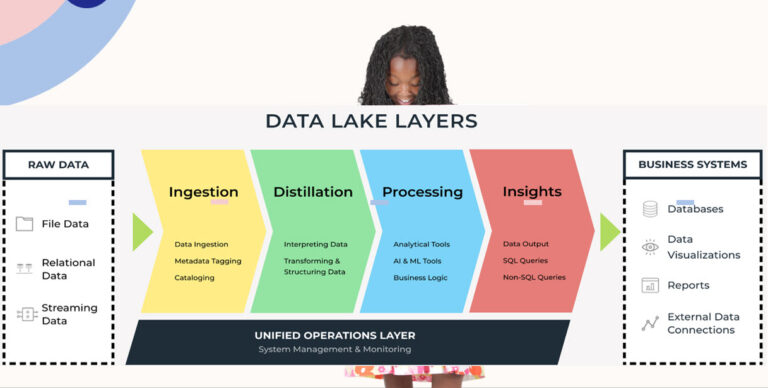
Methods should assist in measurement of data and use of data lakes to report on all controls. It should …

  1. Identify indicators: Ways to compare last year to this coming year; RaaWee data tools can help
  2. Find Benchmarks: External partners to whom we can compare progress and set targets

Tools should ensure indirect control and should…

  1. Give a temperature check on impact for students, staff, climate, and families. For all.
  2. Whether it is MTSS, RTI, PBIS, RaaWee, your own solution or emerging solutions, measurable impact is the goal.

Messaging should meet students’ internal control needs and share what matters…

  1. Convey the importance of schooling and celebrating presence.
  2. Inform of current state and growth yet to come
  3. Value partnership and relationships and role of all
Data Lake Layers

When preventing is knowing, control matters. What matters is tracking methods, tools, and messaging in data lakes where consistent reports of impact from all controls can be gleaned and shared. The lives of our students and their families are in our hands. They must know why schooling, in various formats, matters and that we care.

###

Dr. Carolyn Gentle-Gennity, PhD, Butler University
Carolyn Gentle-Genitty, PhD Butler University

About the Author

Dr. Carolyn Gentle-Genitty, founder, lead consultant, and Chief Education Officer for Pivot Attendance Solutions, has inspired many administrators, educators, students, and school social workers as a past chair of the school’s concentration Masters Curriculum, tenured professor, and Director of the Bachelors for Social Work Program. Having worked closely with the Indiana Department of Education to assist school counselors in acquiring a school counselor license and coordinating curriculum mapping and application, she knows the intricacies of working with school-community partnerships. She has been a forerunner in responding to school absenteeism, truancy, and social bonding. She has over 30 years in youth development, 20 years in dropout and truancy, and more specifically, she brings over 12 years studying, researching, presenting, and writing about absenteeism locally, nationally, and internationally. In the US she is a leader in absenteeism and understanding school attendance problems and translating such into practice models for implementation. She is forging partnerships in colleges to establish the area as a formal field of study.

Strengthening Student Attendance

Promoting strong student attendance has always been an essential focus for public education, but it has never been more critical than today. The challenges posed by the pandemic have significantly disrupted traditional educational experiences, leading to varied forms of learning that left many students disengaged. As we work to welcome students back into the classroom, we must be creative, forward-thinking, and proactive in our approaches. It is vital to invite, encourage, and reassure our students that returning to school is in their best interest, both academically and socially.

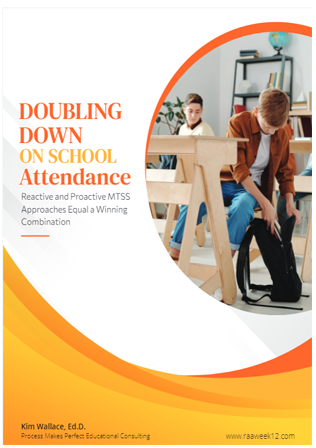
Doubling down on school attendance white paper
Download and Share Complete White Paper

Proactive & Reactive Intervention

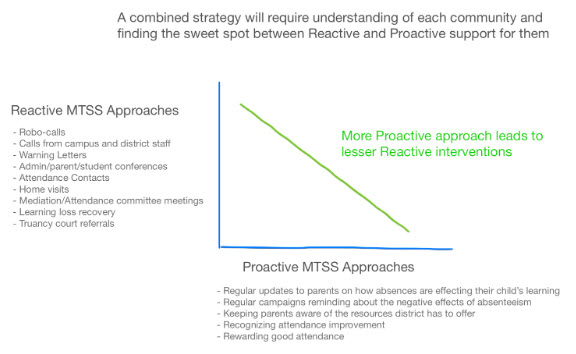
To effectively address attendance issues, schools should implement a combination of proactive and reactive Multi-Tiered System of Supports (MTSS) strategies. Proactive interventions involve anticipating potential barriers to attendance and addressing them before they escalate. This might include regular check-ins with students, monitoring attendance patterns, and identifying students who may be at risk of falling behind. By being proactive, schools can intervene early, providing support and resources to help students navigate challenges before they lead to chronic absenteeism.

Conversely, reactive interventions are equally important for addressing attendance issues that have already arisen. This may involve reaching out to families to understand the reasons behind absences and developing tailored plans to support students’ return to school. Engaging with students who have missed significant time allows educators to adopt a more personalized approach, ensuring that each student’s unique circumstances are recognized and properly addressed.

MTSS Approaches

There is no right or wrong when it comes to proactive versus reactive MTSS-related implementations. The only mistake educators can make is not doing either. That’s why RaaWee K12 Solutions is committed to helping districts of all sizes “double down” by taking a tenacious and resolute approach to empowering staff, students, and families through their MTSS programming. By providing twice the amount of assistance, we can build stronger relationships and create a supportive educational environment. The invaluable rewards of this commitment will extend far beyond improved attendance; they will shape the future success of our students, paving the way for their academic achievements and personal growth.

About the Presenter

Kim Wallace, Professional Educational Consultant & Author at Process Makes Perfect

Born and raised in an educator household, Dr. Kim Wallace started her own career in public education 30 years ago as a high school English and history teacher before becoming a site principal and district office administrator. Her most recent K-12 role was as superintendent of one of the 20 largest school districts in California. 

Kim joined the UC Berkeley School of Education Leadership Programs division as the Associate Director of the 21st Century California School Leadership Academy (21CSLA) State Center in 2020. She also runs her own consulting company Process Makes Perfect, specializing in real world solutions for practitioners in the field. Kim consults, writes, and presents internationally on systems change and emerging trends in educational leadership. An award-winning, innovative educator, Kim leverages her abilities in educational administration, program management, and relationship development to optimize institutional effectiveness and deliver remarkable results.

Dr. Wallace’s book Leading the Launch: A Ten-Stage Process for Successful School District Initiatives was published by Solution Tree Press in 2021, followed by Leading Through an Equity Lens in 2023. Her upcoming book, Gamechanging Leadership in Action: An Educator’s Companion is in production with Routledge/Taylor & Francis (Fall 2025). Kim attended the University of California Santa Barbara for her undergraduate degree in history. She then earned her Master’s in Education (M.Ed.) at the University of California Los Angeles and culminated her educational goals with a Doctorate in Education (Ed.D.) from the University of California Davis.