
Reducing chronic absenteeism is a shared attendance goal across K12 education, but meaningful progress requires more than commitment. It requires clarity.
Many districts have passionate educators, dedicated attendance teams, and intervention strategies already in place. Yet attendance efforts often struggle to gain traction because they operate independently from broader district priorities. When attendance goals are treated as a standalone initiative instead of an essential component of student success, opportunities for collaboration, funding, and long-term sustainability can be missed.
The second session of the Strategic Attendance Planning Playbook workshop series focused on a critical question that every district should answer before launching new attendance initiatives:
Where are we trying to go, and how do we ensure everyone is working toward the same destination?
Attendance Improvement Begins With Alignment
Attendance influences every aspect of a student’s educational experience. It affects academic achievement, student engagement, accountability measures, and district funding. Because of this, attendance cannot be owned by a single department.
Reducing chronic absenteeism requires systems, alignment, and shared ownership. Sustainable attendance improvement occurs when district leaders, campus administrators, student services, academics, communications, PEIMS, and other teams work toward common goals rather than operating independently.
This shift changes attendance from being an operational responsibility to becoming a districtwide priority that supports student success.
Build on What Already Exists
One of the most practical messages from the session was that districts do not always need to create new plans. Instead, they should begin by examining the plans they already have.
Reviewing these existing frameworks can help districts identify and strengthen attendance goals that are already connected to broader priorities.
Reviewing these plans helps districts answer important questions.
- Where is attendance already being addressed?
- Where are the gaps?
- Which departments are already contributing to attendance improvement?
- Where can stronger alignment create greater impact?
This process helps eliminate duplicate efforts while ensuring attendance becomes part of the district’s broader vision for student success rather than an isolated initiative.
Systems Create Sustainability
Individual strategies can improve attendance in the short term. Sustainable improvement depends on the systems that support those strategies over time.
During the workshop, participants were encouraged to examine the infrastructure behind their attendance work by asking questions such as:
- Is attendance data accurate and available promptly?
- Are communication processes consistent across campuses?
- Are interventions documented and monitored?
- Do staff have the tools and training they need?
- Are positive attendance habits recognized and celebrated?
Strong systems also make it easier to track progress toward attendance goals and adjust strategies when needed.
Identify Strengths Before Solving Challenges
Effective planning starts with understanding the current reality.
Participants completed an attendance program self-assessment and a SWOT analysis to identify existing strengths, areas for improvement, future opportunities, and potential challenges.
This type of reflection helps districts make informed decisions instead of relying on assumptions. It also encourages teams to recognize successful practices that can be expanded while identifying barriers that require additional attention.
By understanding both strengths and gaps, districts can prioritize resources where they are needed most.
Put Attendance Goals in Writing
Another important takeaway from the session was the value of documenting attendance goals.
Written goals help establish accountability, create consistency across departments, and strengthen conversations around funding and resource allocation. As discussed during the workshop, what is written is more likely to get funded.
The workshop introduced participants to the SMARTIE goal framework, encouraging districts to develop goals that are:
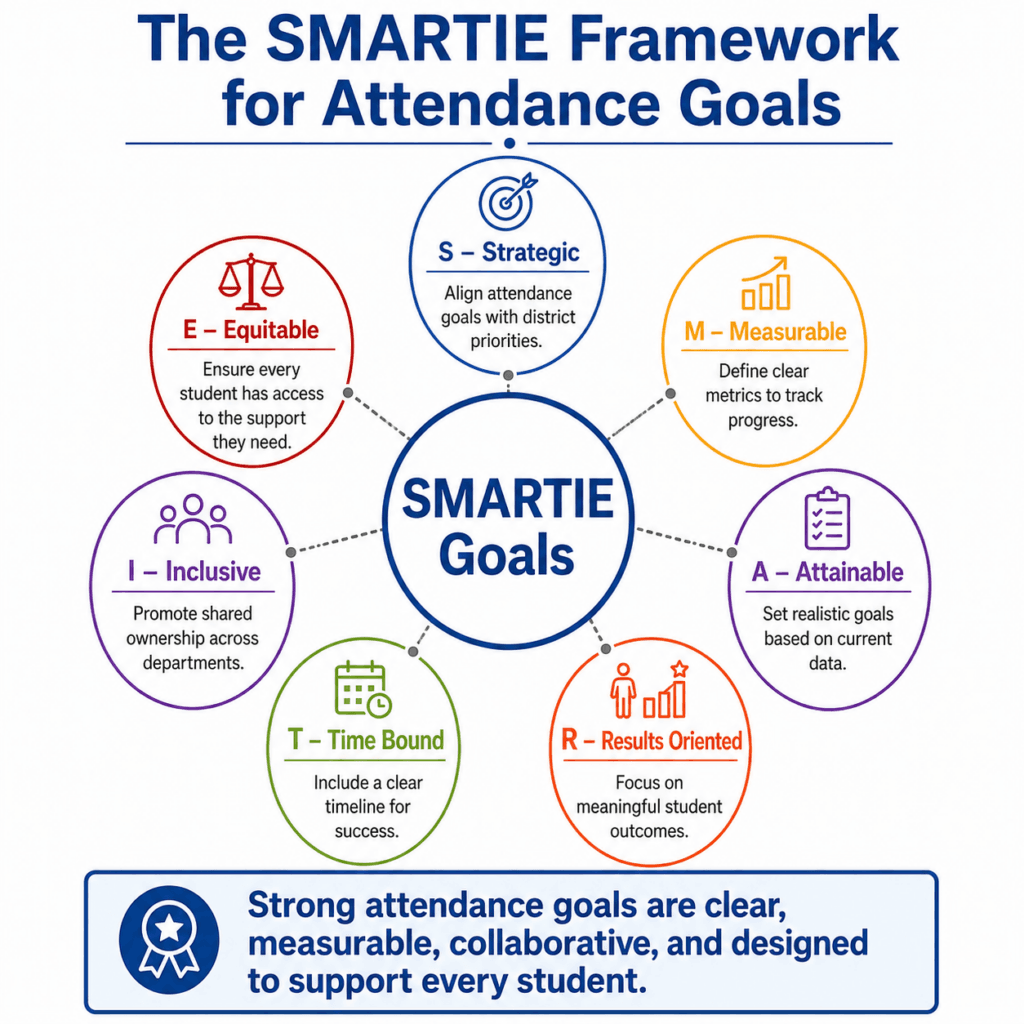
Rather than focusing only on attendance percentages, develop attendance goals that promote shared ownership across departments and ensure every student has access to the supports needed to attend school consistently.
Every District Needs a Shared Destination
Attendance improvement is not about adding another initiative to an already busy calendar.
It is about ensuring that every department understands how attendance supports student success and how their work contributes to that shared outcome.
When attendance goals are aligned with district priorities, supported by strong systems, informed by honest self-assessment, and reinforced through measurable planning, districts create a stronger foundation for lasting improvement.
Agreement on the destination creates clarity. Clarity creates alignment. Alignment makes meaningful progress possible.
Looking Ahead
The next session in the Strategic Attendance Planning Playbook series builds on this foundation by helping districts prioritize their routes. Read to learn how to establish realistic, data-informed attendance goals and identify the interventions that will have the greatest impact for the students.
Additional Resources

About the Presenter
Sharon Bradley is a national educational consultant, author, and speaker with over 25 years of experience in K–12 education. She previously served as a district administrator in the Dallas–Fort Worth area, leading districtwide efforts in truancy prevention and student engagement, and has held roles including student services director, high school principal, assistant principal, and dropout prevention coordinator.
She is the author of Chronic Absenteeism: Prevention and Intervention Strategies for Schools, Families, and Communities and Combating Chronic Absenteeism through Attendance Intervention Plans. Sharon is also a founding member of Attendance USA and was recognized as a 2024 “Leader to Learn From” by EducationWeek and the 2023 “Person of the Year” by the International Truancy and Dropout Prevention Association.
She currently serves as Partner Success Manager at RaaWee K12 Solutions, supporting districts with proven attendance and engagement strategies.