
Improving student attendance cannot rest on the shoulders of a small attendance team.
Districts may have dedicated attendance staff, but the conditions that influence whether students attend school consistently often extend far beyond the attendance office. Anxiety, bullying, health concerns, transportation, housing, food insecurity, family responsibilities, and disengagement can all affect a student’s ability or willingness to attend.
This article, inspired by the fifth session of our Strategic Attendance Planning Playbook series, explores how districts can build internal capacity, strengthen family engagement, and develop community partnerships that create a broader support system for attendance improvement.
Make Attendance Everyone’s Responsibility
Sustainable attendance improvement requires shared ownership.
When attendance is viewed as the responsibility of only a small group of specialists, schools can miss opportunities to identify concerns and provide support for attendance improvement. Teachers, counselors, administrators, family engagement staff, student services teams, and other school employees interact with students and families every day. Building their capacity to recognize early signs of disengagement can help create a more responsive support system.
Professional development can play an important role in this process. Staff need practical guidance on attendance expectations, early indicators of disengagement, communication with families, and the resources available when students face barriers to attendance.
The goal is not to turn every staff member into an attendance specialist. It is to make attendance a shared part of supporting student success.
Start Supporting Students Before Absenteeism Becomes Chronic
Attendance intervention does not have to begin after a student has already developed a pattern of frequent absence.
Proactive communication can begin before the school year starts and continue throughout the year. Positive summer outreach, welcome messages, family education, and early communication about attendance expectations can help establish relationships before concerns arise.
Schools can begin addressing barriers before absenteeism becomes a chronic pattern, making proactive support an important part of attendance improvement. Safe learning environments, restorative practices, and attention to social-emotional barriers such as anxiety and bullying can influence whether students feel that school is a place where they belong.
Early support is not about assuming that every absence signals a serious problem. It is about creating systems that make it easier to notice concerns and respond appropriately.
Look Beyond the School Building
Some attendance barriers schools cannot address alone.
A family experiencing housing instability may need access to a housing resource. A student facing food insecurity may need assistance from a community organization. A family dealing with health concerns may benefit from connections to local healthcare providers.
This is where community partnerships become an important part of an attendance strategy.
Districts can identify organizations that already serve families in their communities and determine how those resources can complement school-based support. Local businesses, healthcare organizations, community centers, faith-based organizations, city agencies, and nonprofit organizations may each have resources or relationships that can help address barriers affecting attendance.
The objective is not to create another program for every problem. It is to understand what resources already exist and create pathways for families to access them.
Map the Assets Already in Your Community
Before building new partnerships, districts can take inventory of the resources they already have.
Asset-based community mapping provides a practical way to identify organizations, services, gathering places, and trusted community voices that can support students and families.
A community resource directory can make this information easier for school staff to use. Instead of expecting each staff member to search for resources when a family needs help, districts can organize contact information for services such as housing assistance, food support, healthcare, and grief support in one accessible resource.
Districts do not necessarily need to build these directories from the ground up. Existing community resource networks and databases can provide a starting point, like this resource.
The value comes from knowing what is available, keeping the information organized, and making it easier for the people supporting students to connect families with appropriate resources.
Make Family Engagement More Accessible
Family engagement becomes more meaningful when families have accessible ways to participate in attendance improvement efforts.
Traditional parent events may not work for every family. Work schedules, transportation, childcare, language, and previous experiences with schools can all affect whether families feel comfortable participating.
Districts can create more accessible opportunities through flexible meeting times, virtual options, asynchronous resources, childcare, multilingual communication, and community-based locations.
Listening sessions can be particularly valuable because they allow families to share their experiences and perspectives. Families often have insight into barriers that may not be visible from the school’s perspective.
The question is not simply, “How do we get parents to attend our event?”
A better question is:
How can we create opportunities for families to help shape the solutions?
Work With Trusted Messengers
Schools are not always the only trusted source of information within a community.
Community leaders, local organizations, businesses, faith-based organizations, and other trusted messengers can help districts reach families in places where they already gather and feel comfortable.
Community events can also create opportunities for attendance outreach without requiring families to come to a school building. Local events, neighborhood gatherings, and other community activities can provide natural settings for sharing attendance resources and connecting families with support.
The strength of these partnerships comes from relationships. A community partner should not simply be viewed as a place to distribute flyers. Stronger partnerships involve shared understanding of community needs and a willingness to work together on solutions.
Build Capacity Through Collaboration
Districts do not have to solve attendance challenges independently.
Collaboration with neighboring districts and community organizations can create opportunities to share ideas, resources, and approaches to challenges that may affect multiple communities.
At the same time, collaboration within the district remains essential. Attendance teams, school leaders, student services, family engagement staff, educators, and community partners each see different parts of the attendance picture.
Bringing those perspectives together can lead to more informed decisions and more coordinated support to improve attendance.
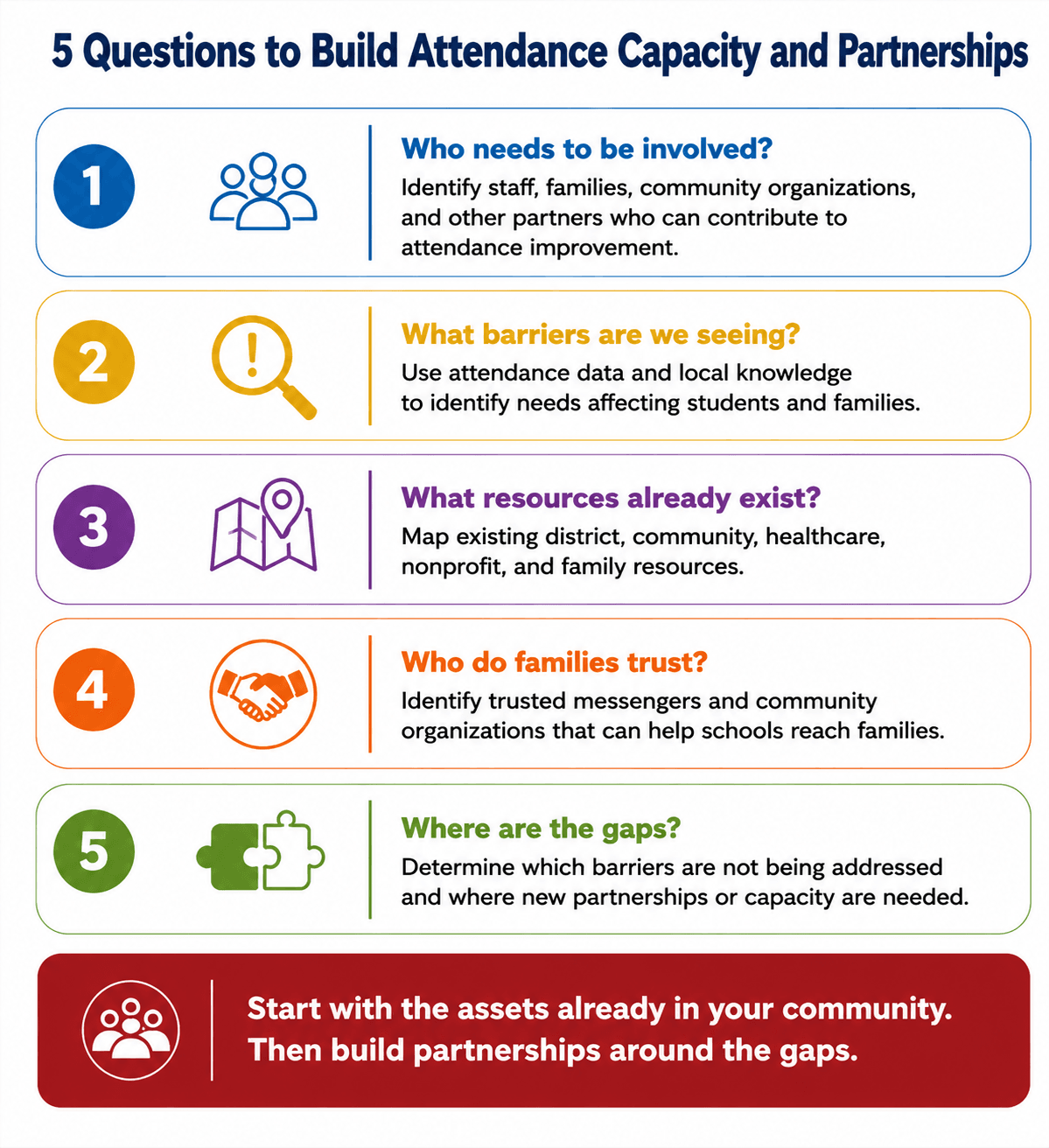
Build the Support System Around the Student
Attendance improvement becomes more sustainable when districts stop thinking of it as a single intervention and start thinking about the network of support surrounding each student.
That network can include educators who recognize early signs of disengagement, families who feel comfortable communicating with the school, staff who know where to find community resources, and partners who can help address barriers that extend beyond the classroom.
Building that network takes time. It also requires planning, clear roles, and ongoing communication.
But the objective is straightforward:
Create a community where students and families have access to the relationships, resources, and support they need to attend school consistently.
When districts build capacity internally and strengthen partnerships externally, attendance improvement becomes a shared effort rather than the responsibility of a few.
Looking Ahead
The next article in the Strategic Attendance Planning Playbook series brings the planning process together by focusing on sustaining the work, strengthening collaboration, and turning an attendance strategy into an ongoing district practice.
Additional Resources

About the Presenter
Sharon Bradley is a national educational consultant, author, and speaker with over 25 years of experience in K–12 education. She previously served as a district administrator in the Dallas–Fort Worth area, leading districtwide efforts in truancy prevention and student engagement, and has held roles including student services director, high school principal, assistant principal, and dropout prevention coordinator.
She is the author of Chronic Absenteeism: Prevention and Intervention Strategies for Schools, Families, and Communities and Combating Chronic Absenteeism through Attendance Intervention Plans. Sharon is also a founding member of Attendance USA and was recognized as a 2024 “Leader to Learn From” by EducationWeek and the 2023 “Person of the Year” by the International Truancy and Dropout Prevention Association.
She currently serves as Partner Success Manager at RaaWee K12 Solutions, supporting districts with proven attendance and engagement strategies.