
A strategic attendance plan is only as effective as its implementation.
Districts can establish goals, identify priorities, select interventions, communicate the attendance plan, and build partnerships. But lasting improvement requires something more: a system for putting those strategies into practice, monitoring progress, and adapting when the results do not match expectations.
This article, inspired by the sixth and final session of our Strategic Attendance Planning Playbook series, explores how districts can move from planning to continuous improvement while building systems that sustain attendance efforts over time.
Implementation Is Where Strategy Becomes Practice
A written attendance plan creates direction. Implementation turns that direction into daily practice.
For implementation to work, attendance cannot remain isolated within one department. District administrators, campus leaders, educators, PBIS teams, student services professionals, and other school community stakeholders all have a role in supporting consistent attendance. The goal is to make attendance part of the way the district operates rather than an initiative managed by a small group.
This requires more than assigning responsibilities. Staff need the knowledge, tools, time, and support to carry out the strategies identified in the attendance plan.
Regular team discussions can help districts identify what is working, where staff needs additional support, and where processes need strengthening.
Build Systems That Can Sustain the Work
Attendance improvement should not depend on one person knowing what to do.
When effective practices exist only through individual knowledge or effort, progress can become difficult to maintain when responsibilities change. Written processes, shared expectations, consistent data practices, and clear intervention pathways help protect the work from becoming dependent on individual staff members.
The goal is to become system-dependent, not person-dependent.
A sustainable attendance system should also connect attendance to the district priorities already guiding the work. Attendance can support efforts related to literacy, mathematics, state assessments, graduation, college and career readiness, and school connectedness.
When attendance is embedded within existing priorities, it becomes part of the district’s broader approach to student success.
Monitor What Is Happening in Real Time
Without monitoring, implementation can be difficult to assess.
Regular monitoring also helps teams determine whether the attendance plan is producing the intended results or whether adjustments are needed. The goal is to move beyond simply recording absences and toward using attendance information to inform timely decisions.
Integrated technology can support this process by making attendance data and intervention information easier to manage. RaaWee ATTENDANCE+™ is designed to help districts monitor attendance and manage interventions, giving teams tools to identify attendance concerns and support timely follow-up.
Technology, however, is only part of the process. Data becomes useful when teams regularly review it, discuss what it means, and use it to determine what should happen next.
Measure Improvement, Not Just Activity
It is possible to implement an attendance strategy without knowing whether it is actually improving outcomes.
Districts should define what improvement looks like before evaluating a strategy. That may include examining changes in attendance over time, reviewing specific student groups, or establishing regular checkpoints throughout the year.
The focus should be on meaningful measures rather than simply counting how many interventions were completed.
For example, a district might examine attendance patterns among students experiencing housing instability or students in foster care to determine whether existing supports are reaching the students who need them. Looking at specific groups can help teams identify where additional attention may be necessary.
The important question is not simply, “Did we implement the strategy?”
It is:
“Did the strategy produce the improvement we intended?”
Use Continuous Improvement to Adapt
Not every strategy will work exactly as planned.
That does not necessarily mean the strategy was a failure. It may mean the district needs to adjust how the strategy is implemented, provide additional support, or reconsider whether the approach addresses the identified barrier.
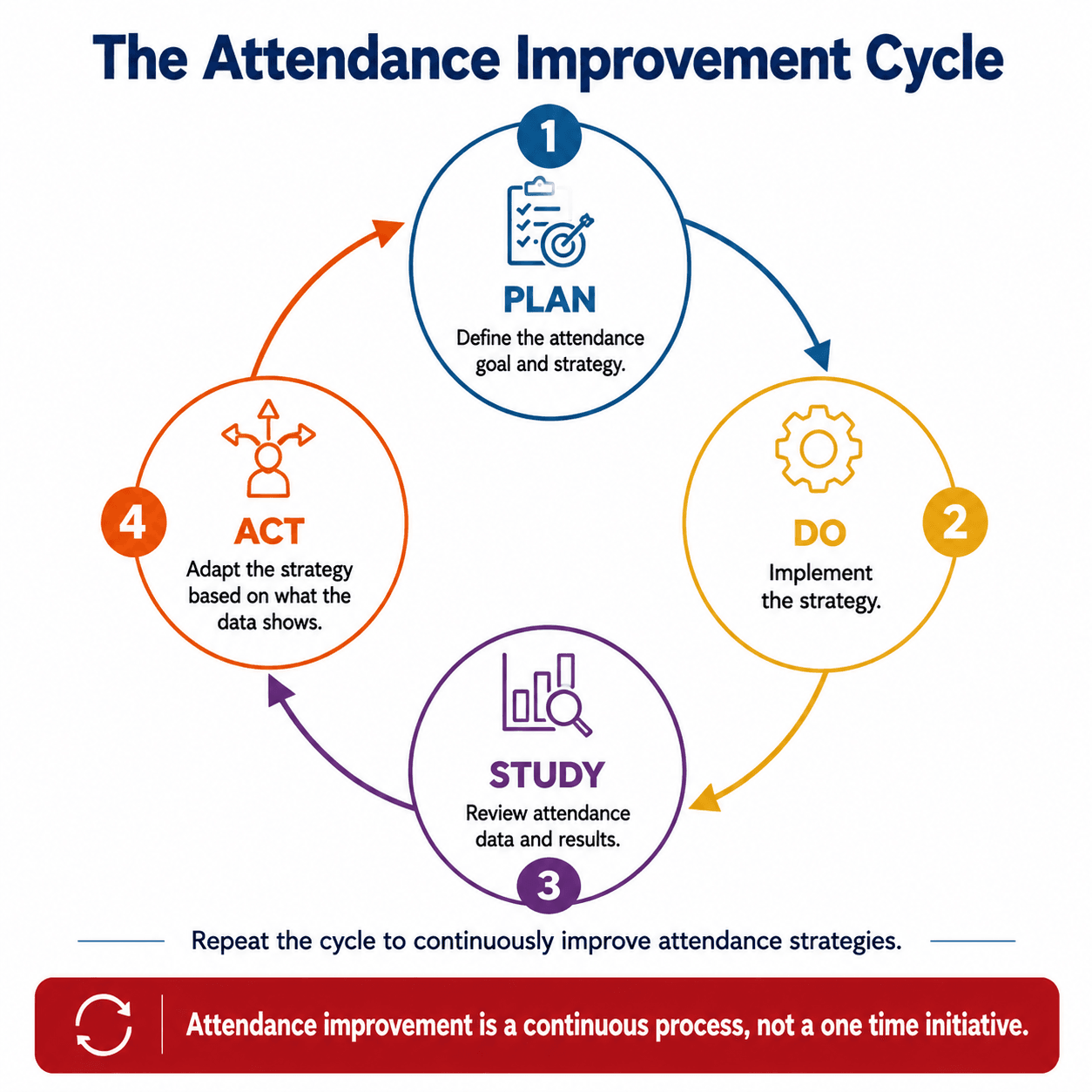
The Plan-Do-Study-Act approach provides a structure for this type of continuous improvement. Teams can identify what they are trying to accomplish, determine how they will know whether a change represents an improvement, and consider what changes may produce better results.
This creates a cycle rather than a finish line. Regular review cycles allow districts to learn from implementation, strengthen the attendance plan, and make adjustments instead of waiting until the end of the school year to determine what worked.
Identify the Gaps Behind the Results
When progress is slower than expected, the next step should be diagnosis, not blame.
Teams can examine whether staff has received sufficient professional development, whether technical support is available, whether intervention processes are clear, and whether teams have enough time to collaborate and problem solve.
The same principle applies to resources.
District leaders may need to demonstrate how attendance data supports investment decisions during budget planning. A cost-impact approach can help teams consider both the expense of an intervention and its potential impact on attendance, instructional minutes, and other district priorities.
This shifts resource conversations from simply asking what something costs to asking what value it provides.
Keep Families and Partners Part of the Process
Implementation does not happen entirely inside the school building.
Families and community partners can provide resources and perspectives that help districts address attendance barriers. Community partnerships may include organizations that support mental health, after-school programming, healthcare, housing, food assistance, or other student and family needs.
Consistent communication and resource sharing can help maintain these relationships as attendance efforts evolve.
The strongest partnerships are not simply activated when a problem appears. They become part of the district’s ongoing support system for students and families.
Make Improvement an Ongoing Practice
Reducing chronic absenteeism is not a one-time project.
Attendance patterns change. Student needs change. Staff responsibilities change. Community conditions change. A strategy that works in one context may need to be adapted in another.
That is why implementation, monitoring, and adaptation need to be built into the attendance plan from the beginning.
A strong attendance strategy gives a district direction. A strong system lets that strategy evolve.
The ultimate goal is not to create a perfect plan that never changes. It is to create a process that allows the district to implement thoughtfully, monitor honestly, learn continuously, and adapt when needed.
When that process becomes part of the district’s way of working, attendance improvement becomes more sustainable and less dependent on individual champions.
From Planning to Practice
Across the strategic attendance planning process, districts move through several important stages: building shared ownership, establishing clear goals, prioritizing strategies, communicating the roadmap, developing capacity and partnerships, and finally implementing, monitoring, and adapting the work.
The final step is also what keeps the entire process moving.
A district does not need to have every answer before it begins. It needs a clear strategy, measurable goals, reliable information, shared ownership, and a willingness to learn from what the data shows.
That is how an attendance plan becomes more than a document.
It becomes a system for continuous improvement.
Additional Resources

About the Presenter
Sharon Bradley is a national educational consultant, author, and speaker with over 25 years of experience in K–12 education. She previously served as a district administrator in the Dallas–Fort Worth area, leading districtwide efforts in truancy prevention and student engagement, and has held roles including student services director, high school principal, assistant principal, and dropout prevention coordinator.
She is the author of Chronic Absenteeism: Prevention and Intervention Strategies for Schools, Families, and Communities and Combating Chronic Absenteeism through Attendance Intervention Plans. Sharon is also a founding member of Attendance USA and was recognized as a 2024 “Leader to Learn From” by EducationWeek and the 2023 “Person of the Year” by the International Truancy and Dropout Prevention Association.
She currently serves as Partner Success Manager at RaaWee K12 Solutions, supporting districts with proven attendance and engagement strategies.