
For schools working to improve attendance, attendance patterns often start the conversation. But sometimes, an absence is more than an absence.
Students experiencing homelessness face significant challenges to school attendance, with 47.7% identified as chronically absent during the 2023–24 school year, a rate 22 percentage points higher than other students nationally. Housing instability often brings interconnected challenges such as financial hardship, transportation barriers, and health needs, which directly impede a student's ability to attend school consistently. Recognizing these underlying conditions allows schools to move beyond simply addressing absences and instead target the specific barriers influencing a student’s ability to attend.
Frequent absences, repeated tardiness, fatigue, changes in transportation, or withdrawal from school activities can signal that a student is facing challenges outside the classroom. Housing instability may be one of those challenges.
Understanding that connection can help schools move beyond asking, “Why is this student absent?” and instead consider a more meaningful question:
What conditions may be influencing this student’s ability to attend?
The Connection Between Housing Stability and Attendance
Public schools identified more than 1.5 million children and youth as experiencing homelessness during the 2023–24 school year. Among students experiencing homelessness, 47.7% were chronically absent, 22 percentage points higher than other students nationally.
Source: SchoolHouse Connection, School Attendance Support for Students Experiencing Homelessness (2023–24 data).
These numbers illustrate why housing instability deserves attention within broader attendance improvement efforts. Attendance may be one of the first visible signals of instability that a school has not yet identified. A student may start arriving late more often, seem unusually tired, or stop participating in activities they once enjoyed. These patterns do not automatically indicate homelessness. They are signals that something may have changed.
The goal is not to make assumptions. It is to notice the pattern and create an opportunity for supportive inquiry.
Homelessness Is More Than a Housing Issue
Housing instability rarely occurs in isolation.
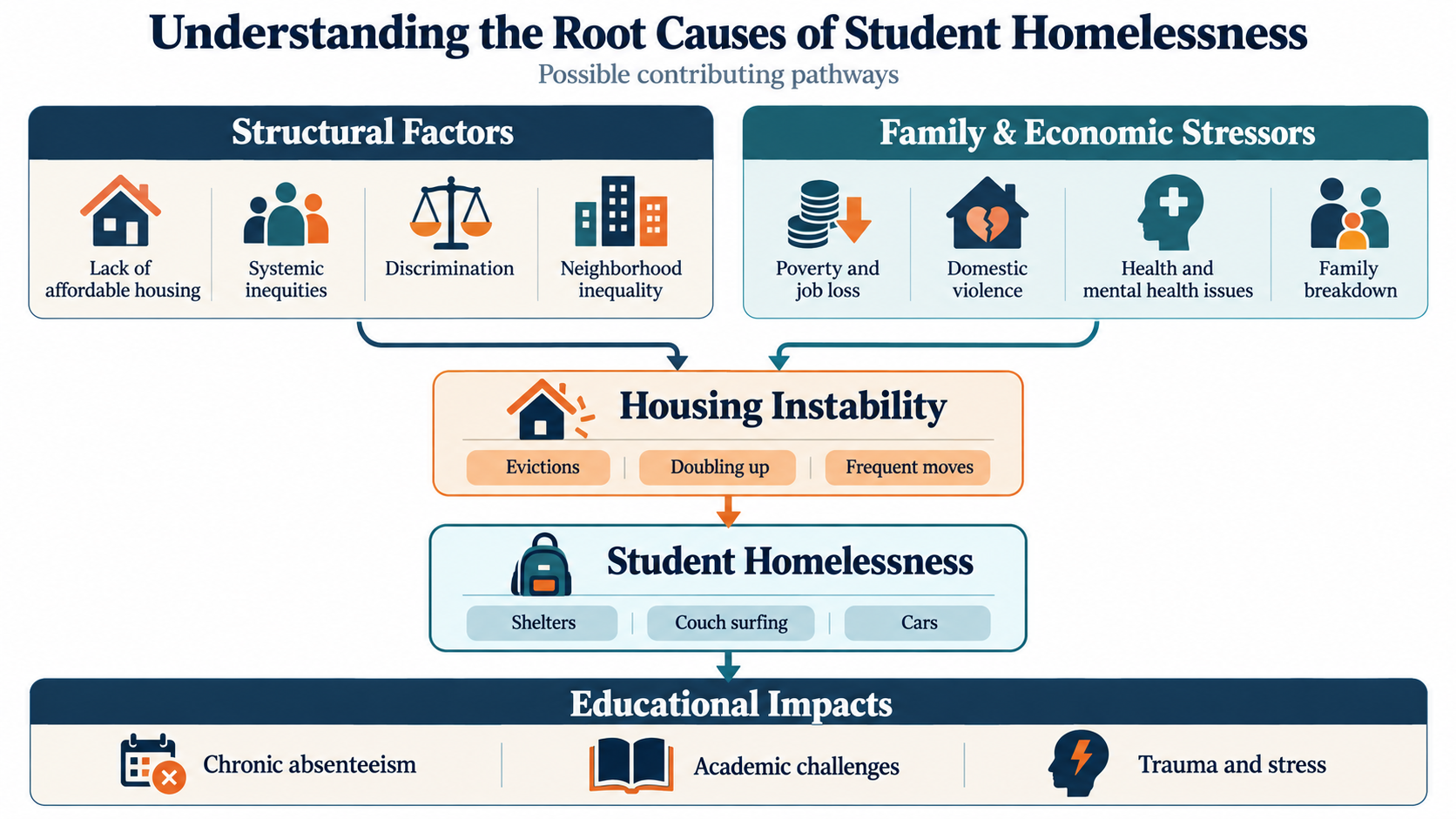
Families may also be navigating financial hardship, transportation barriers, employment instability, physical or behavioral health needs, trauma, disrupted routines, or reduced access to childcare and community supports. These interconnected challenges can affect a student’s ability to get to school consistently.
When family stability decreases, attendance can become more difficult, not because education is unimportant to the family, but because immediate needs may take priority. Housing instability itself can take different forms, including staying in shelters, temporarily sharing housing with others, couch surfing, or moving frequently between living arrangements.
Recognizing these circumstances helps schools understand that a student’s housing situation may not always be immediately visible.
Target the barrier, not just the absence.
Identify Without Labeling
The language schools use matters.
A student should not be defined by their housing circumstances. The preferred language is “student experiencing homelessness” rather than “homeless student.” This distinction recognizes the experience without turning it into the student’s identity.
The same principle applies when reviewing attendance data. A pattern of absences should not lead educators to label a family or assume the reason. Instead, it should prompt a private, supportive conversation. For example, rather than asking:
“Why are you always absent?”
Consider:
“I’ve noticed it has been harder to get here lately. What’s getting in the way?”
Rather than immediately asking whether a family is staying in a shelter, a more open question might be:
“Where are you staying right now, and is that arrangement temporary or expected to change?”
These conversations should take place privately, with a clear explanation of why the information is being requested. Families should not have to repeatedly retell difficult circumstances to different people within the school system. The purpose of these questions is not simply to collect information. It is to understand what may be getting in the way of consistent attendance and identify how the school can help.
Understanding McKinney-Vento Protections
The McKinney-Vento Homeless Assistance Act protects the educational rights of children and youth who do not have stable housing.
Schools must identify students experiencing homelessness, enroll them promptly even when required paperwork is missing, maintain school stability, and remove barriers that interfere with attendance, engagement, and participation. Understanding these protections is essential to building an effective school response.
District McKinney-Vento liaisons play an important role in identifying students, assessing eligibility, and connecting families with appropriate educational supports. Attendance teams, counselors, administrators, and other school personnel should understand how to recognize possible concerns and coordinate with the district liaison when additional support may be needed.
But effective support also depends on what happens after a concern is identified. Staff need clear referral pathways, defined responsibilities, and coordinated follow-up so families can access assistance without navigating disconnected systems.
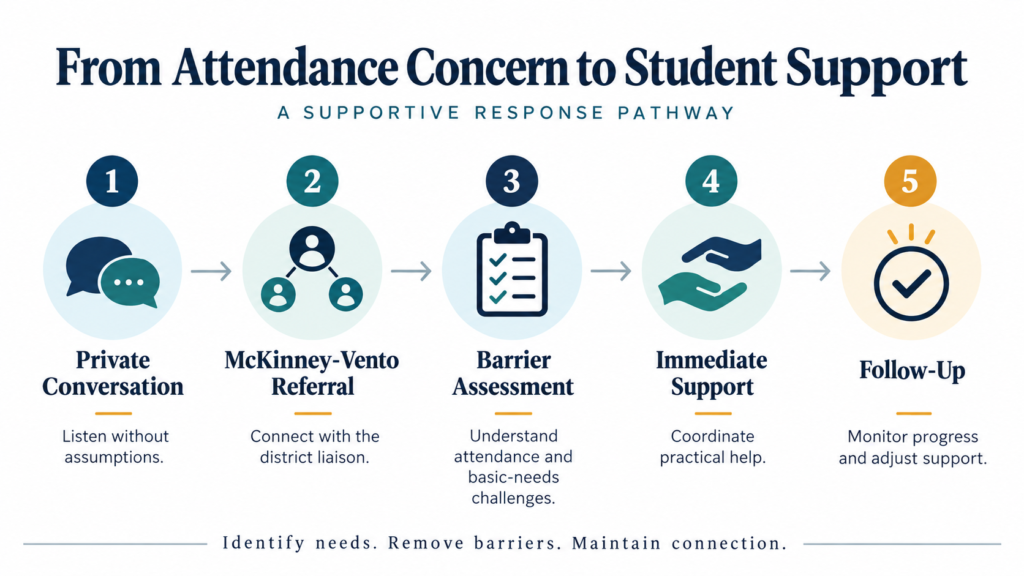
A practical response begins with a private conversation, followed by an appropriate McKinney-Vento referral, an assessment of barriers, immediate support, and continued follow-up.
Integrating Housing Instability Into MTSS
Housing instability should not sit outside the attendance support system.
Schools can thoughtfully integrate homelessness and housing instability into their Multi-Tiered System of Supports (MTSS) to create a more proactive and coordinated response.
Tier 1: Build Awareness and Access
At the universal level, schools can:
- Train staff to recognize possible indicators of housing instability.
- Establish clear referral pathways.
- Use sensitive questions during enrollment and annual updates.
- Make McKinney-Vento information visible without singling out students.
- Create a welcoming environment where asking for help feels safe.
- Routinely review attendance data for patterns that may warrant supportive outreach.
The goal is to create systems in which concerns can be recognized early and families know where to find support.
Tier 2: Address the Barrier
When students need more targeted support, schools can:
- Connect students with a trusted adult or navigator.
- Develop a written attendance success plan with the student and family.
- Address transportation and basic-needs barriers quickly.
- Provide flexible academic recovery and re-entry support.
- Monitor progress and adjust the plan with the family.
At this level, the focus shifts from recognizing concerns to understanding specific barriers and responding with practical support. For example, if transportation arrangements have changed, an attendance plan should consider that barrier rather than focusing only on the number of missed days.
Tier 3: Coordinate Complex Support
Students experiencing more complex instability may need individualized, cross-agency support. This can include coordination across housing, transportation, health, behavioral health, academic, and family services. Clear responsibilities help ensure that support is coordinated rather than fragmented.
Schools should also maintain connections during moves and transitions and minimize how often students or caregivers must repeat their circumstances to different people. Attendance can continue to serve as an early indicator of whether the support plan is working and where adjustments may be needed.
Five Questions for District Teams
Building a stronger response requires looking at the system, not just individual students.
District teams can ask:
- Can every staff member recognize possible indicators of housing instability
- Does attendance data connect easily to McKinney-Vento identification and support?
- Who owns follow-up when a barrier is identified?
- Can families access help without navigating multiple disconnected offices
- How does the district know whether interventions are improving both attendance and family stability?
These questions can help districts identify gaps between recognizing a need and actually providing support. They also encourage school leaders to examine whether attendance, student services, McKinney-Vento, and community support efforts are working together effectively.
Attendance as a Care Practice
Improving attendance for students experiencing homelessness requires more than attendance contracts or consequences alone. When housing instability affects a student’s ability to attend school, meaningful progress begins with understanding and addressing the barriers behind the absence. Schools can build a more supportive response by following a simple framework:
Notice. Identify. Assess. Support. Connect.
This approach transforms attendance from a measure of presence into an opportunity for connection, early intervention, and sustained student support.
Ultimately, the question is not simply, “Why isn’t this student attending?”
It is:
“What conditions are we creating that make it possible for this student to show up and keep showing up?”

About the Presenter
Shelneka A. Marsalone is Founder of We Got Goals, LLC and Executive Director of Attendance USA, where she leads national efforts to combat chronic absenteeism.
A recognized subject matter expert on attendance and engagement, she trains educators at the state, district, and school level and represents the U.S. on the International Network for Student Attendance. She created RESET, a reentry initiative that has helped participating schools cut suspension referrals by double digits, and My Mother’s Ministry, which provides hygiene kits to students and women experiencing homelessness. She is also the author of Homelessness: An Educator’s Guide to Understanding, Assessing & Supporting Students.