Shifting Truancy Intervention

Rebecca Clark and Jennifer Boniol from Lewisville ISD discussed shifting truancy interventions from compliance to student-centered approaches. They use the RaaWee Attendance+ tool for data management and introduced the ADAPT program for counseling, HOPE for substance abuse, and CHOICES for family support, leveraging tiered support from counselors and social workers for holistic intervention.

A Shift from Compliance to Support

Lewisville ISD has transitioned from traditional truancy enforcement to student-centered strategies, adapting to legal changes that limit punitive measures. By addressing the root causes of absenteeism, the district ensures students receive the support they need to stay engaged in school.

Leveraging Data for Early Absenteeism Interventions

With the implementation of RaaWee Attendance+ solutions, staff gain real-time attendance insights, enabling them to identify at-risk students early and intervene proactively. This data-driven approach allows for targeted support rather than reactive discipline.

ADAPT: Counseling for Student Success

A key initiative, ADAPT, is a three-week small group counseling program for students and parents, offered across all five high schools. The program focuses on self-awareness, social skills, and decision-making, serving as both a pre-court intervention and a court-ordered option for struggling students.

Comprehensive Mental Health and Family Support

Lewisville ISD provides additional resources like the HOPE program for substance abuse and the CHOICES program for family counseling. A tiered intervention system, involving campus counselors, Student Assistance counselors, and social workers—ensures that students facing mental health or family challenges receive the right support.

Expanding Intervention Resources for Lasting Impact

Key priorities include expanding ADAPT, refining counseling referral criteria, and enhancing collaboration between administrators and counseling staff. By emphasizing intentional communication and student well-being, Lewisville ISD ensures truancy interventions are both supportive and effective.

 Description

Angela, a former teacher and at-risk coordinator, shared Garland ISD’s enrollment/dropout recovery process. She introduced “Operation Opportunity” to streamline efforts, highlighting initiatives like “LEAP” and “RISE.” With clear processes, multi-channel communication, RaaWee Attendance+, and attendance teams, 67% advanced to sophomores, and 85% graduated or continued, ensuring year-long student support.

Operation Opportunity: A Structured Approach

Garland ISD’s enrollment / dropout recovery process is built on clear expectations, documented procedures, and multi-channel communication. Through Operation Opportunity, the district streamlined efforts to re-engage students, launching key initiatives like LEAP and RISE to expand academic opportunities.

Reconnecting Individual Students to Education (RISE) Program

The RISE program provides flexible schedules, online courses, and individualized support, helping 67% of participants advance to sophomore year and 85% either graduate or continue their education.

Attendance Teams for Targeted Interventions

Specialists are assigned to high schools to closely monitor attendance and implement interventions. Dedicated administrators track trends by grade level and demographics, ensuring early support for at-risk students. Home visits and partnerships with programs like McKinney-Vento and Hazel Health further assist vulnerable students and families.

Incentives and Year-Round Engagement

Garland ISD maintains a year-long focus on attendance goals, prioritizing data accuracy and celebrating small wins. Community-sponsored incentives reward students for improved attendance, reinforcing positive habits.

Leveraging RaaWee Attendance+ for Efficiency

With clear staff training and digital tools like RaaWee Attendance+, the district enhances student tracking and intervention efficiency. A Multi-Tiered System of Support (MTSS) framework further aids struggling students, ensuring they receive the help they need.

Accountability and Long-Term Success

Angela emphasized the importance of clear documentation, collaboration between district and campus teams, and strong accountability measures. By aligning enrollment recovery efforts with structured strategies, Garland ISD fosters long-term student success.

About the Presenter

Angela Daniels, M.Ed., Student Engagement Administrator, Student Services, Garland ISD, TX

Angela is a former Intervention Coordinator and teacher with 20 years of experience developing unique opportunities to help all students succeed. She has led initiatives that have reduced dropout rates and enhanced student engagement. She holds certifications in Education Leadership and Dropout Prevention.

Description

Gabriela Pulido and Donna Minix discussed Katy ISD‘s truancy prevention efforts. Serving 88,465 students, the district saw attendance peak at 99.74% in 2019-2020 but declined slightly post-pandemic. To combat this, the dropout and chronic absenteeism prevention teams use RaaWee Attendance+, now expanding district-wide, to track attendance, sign AIPs electronically, and monitor communications effectively. 

A Data-Driven Approach to Attendance

Katy ISD, serving over 88,000 students across 70 campuses, has implemented targeted interventions to minimize truancy. While attendance peaked at 99.74% in 2019-2020, a slight decline followed the pandemic. The Dropout Prevention Department, led by Gabriela Pulido, collaborates with facilitators, social workers, and police officers to keep students engaged.

Structured Truancy Interventions

The district closely monitors attendance trends, implements Attendance Improvement Plans (AIPs), and follows a structured truancy flow chart, utilizing warning letters and court referrals when necessary. Partnerships with programs like Triad provide additional truancy prevention support.

Expanding the Use of RaaWee Attendance+

After a successful pilot in six schools, RaaWee Attendance+ is now being scaled district-wide. The platform offers real-time attendance reports, electronic AIP signatures, and email tracking, enhancing communication and intervention efforts.

Holistic Attendance Support for Students

Beyond attendance tracking, Katy ISD integrates character education, mental health services, and crisis intervention to support student well-being. These initiatives reinforce the district’s commitment to keeping students in school and engaged.

Collaboration for Continuous Attendance Improvement

With a low dropout rate, 167 students in 2019-2020 and 273 last year, Katy ISD remains focused on refining strategies and fostering a culture of attendance. By expanding digital tools and strengthening community partnerships, the district continues to make strides in reducing truancy.

RaaWee Definitive Guide

Strategic Attendance Planning Playbook for Next Year

Virtual Workshop Series

To support districts in applying the framework, a six-part virtual workshop series has been developed based on the guide. Designed for district leaders, campus administrators, attendance teams, and student services professionals, the series helps teams move from understanding the framework to using it in a purposeful way as they prepare for the upcoming school year.

Each session focuses on a specific component of the guide and includes an overview, guided discussion, and dedicated time for action planning. Participants will work through the framework step by step, applying it directly to their district context and building a stronger, more coordinated approach to attendance for next year.

Series Schedule

April 21: Organize and Mobilize Your Team
April 28: Agree Upon Destination
May 5: Prioritize Routes
May 12: Share Your Roadmap
May 19: Build Capacity and Partnerships
May 26: Implement, Monitor, and Adapt

What You Will Gain

🔹Weekly, actionable steps that can be implemented immediately

🔹A structured, district-specific attendance playbook

🔹Participants will receive CEU credits

🔹Ongoing support through session recaps and summaries

Definitive Guide to Attendance Improvement

Student attendance remains a foundational driver of academic success, yet improving it continues to be a complex challenge for many districts.

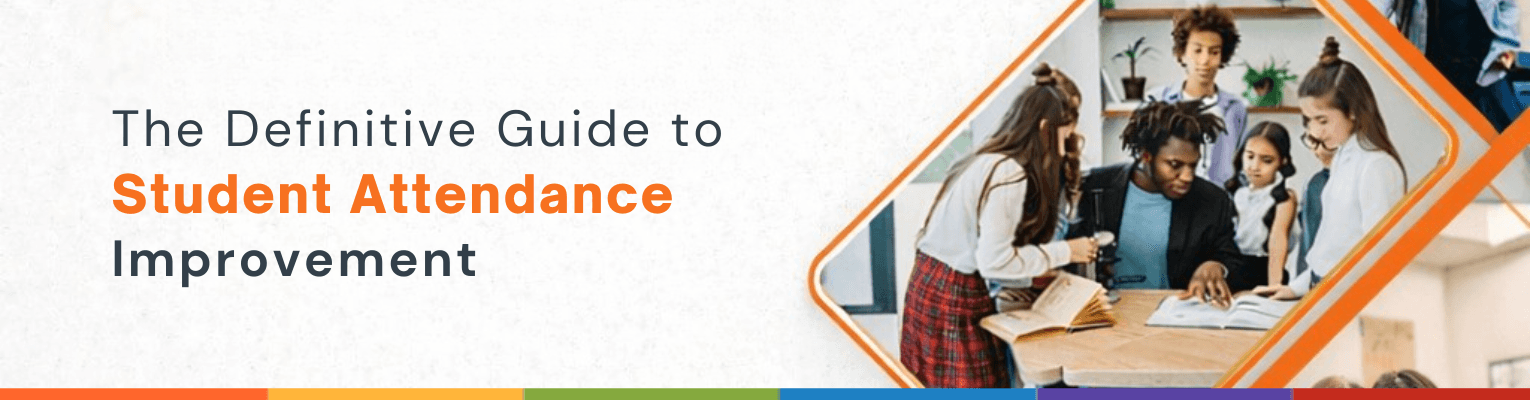
The Definitive Guide to Student Attendance Improvement was developed to support school and district leaders with a clear, structured approach to this work. It provides practical, actionable strategies that can be integrated into existing plans, helping teams move beyond tracking attendance toward building a coordinated, system-wide effort.

The guide emphasizes collaboration, shared responsibility, and planning, while also supporting districts in leveraging RaaWee Attendance+ tools and resources. Its purpose is to help teams create sustainable systems that strengthen student engagement and improve attendance outcomes.

Definitive Guide Implementation Templates

As teams begin applying the framework, the focus shifts from understanding to execution. Turning ideas into a coordinated plan requires structure, clarity, and consistency across teams.

To support this work, a set of implementation templates aligned to the Definitive Guide is available in a format designed for easy access and use during planning sessions.

These templates help teams organize discussions, define priorities, and translate the framework into a clear, actionable attendance strategy.

About the Workshop Facilitator

Sharon Bradley is a national educational consultant, author, and speaker with over 25 years of experience in K–12 education. She previously served as a district administrator in the Dallas–Fort Worth area, leading districtwide efforts in truancy prevention and student engagement, and has held roles including student services director, high school principal, assistant principal, and dropout prevention coordinator.

She is the author of Chronic Absenteeism: Prevention and Intervention Strategies for Schools, Families, and Communities and Combating Chronic Absenteeism through Attendance Intervention Plans. Sharon is also a founding member of Attendance USA and was recognized as a 2024 “Leader to Learn From” by EducationWeek and the 2023 “Person of the Year” by the International Truancy and Dropout Prevention Association.

She currently serves as Principal Consultant at RaaWee K12 Solutions, supporting districts with proven attendance and engagement strategies.

About the Guide’s Author

Born and raised in an educator household, Dr. Kim Wallace started her own career in public education 30 years ago as a high school English and history teacher before becoming a site principal and district office administrator. Her most recent K-12 role was as superintendent of one of the 20 largest school districts in California. Kim joined the UC Berkeley School of Education Leadership Programs division as the Associate Director of the 21st Century California School Leadership Academy (21CSLA) State Center in 2020.

She also runs her own consulting company, Process Makes Perfect, specializing in real-world solutions for practitioners in the field. Kim consults, writes, and presents internationally on systems change and emerging trends in educational leadership. An award-winning, innovative educator, Kim leverages her abilities in educational administration, program management, and relationship development to optimize institutional effectiveness and deliver remarkable results.

Dr. Wallace’s book Leading the Launch: A Ten-Stage Process for Successful School District Initiatives was published by Solution Tree Press in 2021, followed by Leading Through an Equity Lens in 2023. Her upcoming book, Gamechanging Leadership in Action: An Educator’s Companion, is in production with Routledge/Taylor & Francis (Fall 2025). Kim attended the University of California, Santa Barbara, for her undergraduate degree in history. She then earned her Master’s in Education (M.Ed.) at the University of California, Los Angeles, and culminated her educational goals with a Doctorate in Education (Ed.D.) from the University of California, Davis.

Collective Approach to Team Building

Dr. Kim Wallace emphasized collective approaches for student attendance issues, highlighting the need for diverse, high-functioning teams, role clarity, and effective communication. She introduced the concept of “collective agency,” stressing on clear goals, prompt issue resolution, and stakeholder inclusion.

The session covered practical strategies for attendance teams, focusing on defined roles, data-driven decisions, and balancing individual and collective responsibilities, with tools like RaaWee Attendance+ supporting these efforts.

Strategies for Attendance Teams

Dr. Wallace shared strategies that balance individual and team responsibilities. She highlighted the use of tools like RaaWee Attendance+ to support these efforts. Participants were encouraged to reflect on their team dynamics, focusing on voluntary participation, strong relationships, and clear roles beyond job titles.

Levels of Human Agency in Team Building

The discussion covered different levels of human agency: personal, collective, and shared. Dr. Wallace emphasized the power of collective impact in improving student learning and teacher effectiveness. A case study showcased data-driven problem-solving, stressing the need for clear interventions and accountability.

Strategic Alignment for Attendance Improvement

Dr. Wallace noted that when teams align strategically, small efforts can lead to major improvements in attendance management.

Utilizing RaaWee Attendance+

Dr. Wallace introduced RaaWee Attendance+ as a useful tool for analyzing attendance data. She encouraged its use for better decision-making. She also discussed the locus of control, urging teams to focus on areas they can change, rather than getting overwhelmed by larger societal issues.

About the Presenter

Kim Wallace, Professional Educational Consultant & Author at Process Makes Perfect

Born and raised in an educator household, Dr. Kim Wallace started her own career in public education 30 years ago as a high school English and history teacher before becoming a site principal and district office administrator. Her most recent K-12 role was as superintendent of one of the 20 largest school districts in California. 

Kim joined the UC Berkeley School of Education Leadership Programs division as the Associate Director of the 21st Century California School Leadership Academy (21CSLA) State Center in 2020. She also runs her own consulting company Process Makes Perfect, specializing in real world solutions for practitioners in the field. Kim consults, writes, and presents internationally on systems change and emerging trends in educational leadership. An award-winning, innovative educator, Kim leverages her abilities in educational administration, program management, and relationship development to optimize institutional effectiveness and deliver remarkable results.

Dr. Wallace’s book Leading the Launch: A Ten-Stage Process for Successful School District Initiatives was published by Solution Tree Press in 2021, followed by Leading Through an Equity Lens in 2023. Her upcoming book, Gamechanging Leadership in Action: An Educator’s Companion is in production with Routledge/Taylor & Francis (Fall 2025). Kim attended the University of California Santa Barbara for her undergraduate degree in history. She then earned her Master’s in Education (M.Ed.) at the University of California Los Angeles and culminated her educational goals with a Doctorate in Education (Ed.D.) from the University of California Davis.

Description

The meeting discussed the HEB ISD’s truancy prevention and student success initiatives. Key points included the district’s demographics and graduation rate. The truancy process involves warning letters, parent contacts, and administrative conferences, escalating to court referrals at 13 unexcused absences. Serving 22,837 students, the district uses the RaaWee Attendance+ system tools for tracking and emphasizes timely interventions, community service, and character education programs to improve attendance and achievement.

Chronic Absenteeism & Truancy Interventions

The state-mandated truancy plan includes warning letters at three unexcused absences, parent contact, and student-administrator conferences. At six absences, a parent conference is held, and intervention programs are considered. Nine absences result in in-school suspension (ISS), and at thirteen, the truancy department may refer the case to court, prioritizing family support before legal action. This proactive approach aims to combat chronic absenteeism and ensure students remain engaged in their education.

Elementary students follow a similar process, with tardiness cases escalating from parent contact at five tardies to potential court filing at 30. The truancy department engages families through phone calls, home visits, and campus support to address chronic absenteeism early on.

Community Involvement in Attendance Awareness

Community involvement includes food drives, mobile pantries, and the TEAMS character education program. Retired professionals counsel at-risk families, and Hope Academy provides alternative learning environments.

Ongoing Support and Student Engagement

Best practices include a “hero board” to promote punctuality, door hangers for outreach, and rigorous documentation via RaaWee Attendance+ system tools. The department monitors attendance trends, tracks sibling comparisons, and emphasizes swift intervention for better outcomes.

Regular follow-ups ensure effective chronic absenteeism prevention, keeping students engaged and in school.

About the Presenter

Xavier Warren, Truancy Officer, Hurst-Euless-Bedford ISD, TX. 

Xavier Warren is a dedicated professional in the Truancy Department at Hurst-Euless-Bedford Independent School District, focused on improving student attendance and fostering accountability. Committed to educational equity, he addresses barriers to truancy, ensuring all students have the chance to succeed.

Through proactive communication and targeted interventions, Xavier collaborates with families, teachers, and community stakeholders to develop effective strategies that promote regular attendance. His expertise in building relationships has positively impacted student engagement and academic success.

Additionally, Xavier serves as the current president and has served as past treasurer of the Texas Association of Truancy & Dropout Prevention (TATDP), committed to best practice networking with his fellow professionals.

Powerful Attendance Improvement

Allison Woods, Assistant Superintendent of Warren Township, shared the district’s attendance efforts. With 11,500 students, including 16% with disabilities and 17% multilingual learners, proactive tracking and engagement reduced chronic absenteeism by 15%. Partnering with RaaWee Attendance+ improved attendance by 8%+ in a year, supported by tiered interventions and family outreach.

The Importance of Student Attendance for Academic Success

Schools increasingly recognize student attendance as vital for academic success. This case study explores MSD Warren’s initiative to improve attendance rates by addressing barriers and fostering accountability. Through strategic communication and targeted interventions, MSD Warren Township has achieved significant improvements.

Background: Challenges in Attendance Rates

Initially, MSD Warren faced attendance rates around 85.11% during the 2021-2022 school year. As a result, different strategies produced uneven results. To address this, the district launched a plan to improve communication, accountability, and student engagement.

Key Strategies for Improving Student Attendance

  • Cultural Shift in Attendance Perception: The initiative started with changing how attendance was viewed. It stressed the importance of being present for both success and well-being through discussions with families and students.
  • Systematic Attendance Plan: Additionally, a clear plan outlined communication methods, competitions, and recognition for good attendance, promoting responsibility.
  • Proactive Communication: Family engagement liaisons also called families of chronically absent students to build support early on.
  • Tiered Intervention Model: The district implemented a model that addressed attendance issues at three levels, ensuring responses matched the severity of the problem.

Results: Significant Improvements in Attendance Rates

By the end of the 2022-2023 school year, attendance rates improved to about 94%. This change reflects effective strategies and a united effort from the school community.

Conclusion: Lessons Learned for Enhancing Student Attendance

In conclusion, MSD Warren’s approach serves as a helpful example for other schools. By addressing barriers and encouraging accountability, the district raised attendance rates and improved student outcomes. This shows the value of teamwork and proactive actions in making meaningful changes.

About the Presenter

Allison Woods, Asst Superintendent for Exceptional Learners and Whole Child at MSD Warren Township

Allison Woods is an accomplished educator and administrator at MSD Warren Township, dedicated to fostering a positive learning environment and enhancing student achievement. With a strong educational background, she implements innovative teaching strategies and supports teachers in their development. Her commitment to student success is evident through her collaboration with families, staff, and community partners, creating a supportive atmosphere that empowers students.

Allison has been involved in initiatives aimed at improving educational outcomes and promoting equity within the district. Her leadership and dedication have made a significant impact on the MSD Warren Township community, inspiring both students and educators.

Improving Overall Student Attendance

Angela Daniels from Garland Independent School District (ISD) in Garland, TX, recently shared valuable strategies her team employed for student attendance improvement and dropout recovery, showcasing remarkable success in increasing high school attendance from 90.59% in 2023 to 93.2% in 2024. With a student population of 51,000 spread across 70 campuses, Garland ISD faces significant challenges in terms of truancy, which affects approximately 14% of students, and chronic absenteeism, impacting around 9%. Given that 72% of students are economically disadvantaged and 50% classified as at-risk, addressing attendance issues is paramount for the success and well-being of students in the district.

To support their attendance intervention efforts, Garland ISD utilizes the RaaWee Attendance+ system, which provides essential tools and reporting capabilities. This system aids the district in tracking attendance interventions, showcasing proof points, and analyzing trends related to student instructional minutes and funding recovery efforts. By leveraging data effectively, the district can pinpoint areas needing improvement and measure the impact of their strategies.

Addressing Dropout Recovery

Focusing specifically on high school students, particularly ninth graders, the district implemented root cause analysis and flexible scheduling to identify key problem areas affecting attendance. Attendance specialists were designated at each campus, and data was meticulously analyzed by grade level, race, gender, and teacher impact. Recognizing that transition years, such as moving from eighth to ninth grade, often present challenges, the district prioritized these students through home visits and summer outreach initiatives.

One notable initiative is the RISE program, which allows students to customize their schedules to accommodate personal and family challenges. This program encourages collaboration with counseling, special programs, and other stakeholders to establish fair and equitable criteria for participation. Impressively, 85% of participants in the RISE program continued their education or graduated, highlighting the program’s effectiveness.

Angela emphasized the importance of data analysis, collaboration, and celebrating small wins throughout the process. She also stressed the necessity of structured plans, ongoing checkpoints, and stakeholder involvement that extends beyond just the attendance team. By creating equitable solutions and fostering engagement and positive attendance, Garland ISD is dedicated to supporting students in staying present, connected, and thriving in their educational journeys. Their comprehensive approach serves as a model for other districts striving to improve student attendance and overall success.

About the Presenter

Angela Daniels, M.Ed., Student Engagement Administrator, Student Services, Garland ISD, TX

Angela is a former Intervention Coordinator and teacher with 20 years of experience developing unique opportunities to help all students succeed. She has led initiatives that have reduced dropout rates and enhanced student engagement. She holds certifications in Education Leadership and Dropout Prevention.

from EDMS Expert Series: 02/17/2023

Interventions for Chronic Absenteeism

You cannot punish me if I am not there. Absent students have been screaming this at schools forever. It is a scapegoat complex. Schools believe adding more punishments or rewards will change behavior. It’s true, but only if the student shows up. Students with prolonged absences, for any number of reasons, become separated from the people and the process. No amount of incentives, positive or negative, will get them back. Wholistic targeted interventions, emphasizing people and services, aimed at re-establishing bonds at tier 3 is what is required. This session engages the participants in reviewing a common few interventions, some emerging ones, and top three tips on how to develop your own. In sum, prolonged absence, and avoidance, is more about the school and the people than the academics.

Beware the Likes

With every social media post comes the “likes” and “shares.” Whether we had a great dinner, passed a test, or just went somewhere new, our experiences are being rated. Of late, the rating has moved beyond the experience to a reflection of how much the person and their experiences are liked or un-liked.

The video RATED asked how many stars would you give yourself, if you were truly being honest about your actions, behaviors, and thoughts around others. Then imagine, based on that rating, you walked around with everyone knowing whether you were a 5 or a 1-star person. Even further, imagine your star now influencing your experiences; where ate, services you received, who talked to you, and how others perceived you?

Rating

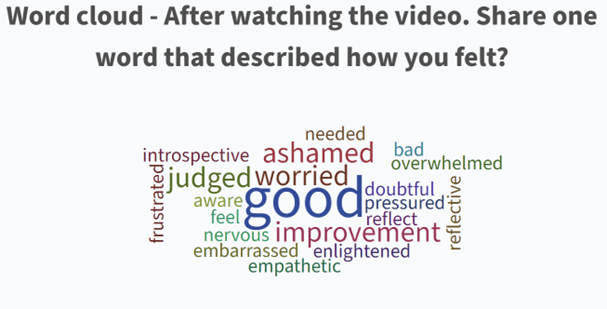
The audience was asked to give their reactions on how they felt after watching the video trailer. Evident below some said it would feel good. Presumably, those were the ones with 4 or 5 stars who would want others to see that they have been good, kind, and trustworthy. On the contrary, many noted they feel bad, ashamed, pressured, embarrassed, frustrated, worried, and even nervous.

Word cloud

Embracing Multi-Tiered System of Supports (MTSS)

The exercise gives us a glimpse into the thinking of students who have higher degree of absenteeism. Though we have embraced evidence-based practices like the Multi-Tiered System of Supports (MTSS) grounded in public health and framed as an organizing model for response and interventions, the model rates students. Upon reflection, it is a structure, which inadvertently labels students and limits service access based on that label. Thus, when trying to encourage students with prolonged absences to return and engage, they too feel bad, nervous, pressured, frustrated, ashamed, worried, judged, and so on. They feel their good may have been overlooked. The one or two wrong was judged incorrectly and there is no recovery.

Viewing Intervention through a New Lens

The topic my absence, your problem speaks to our response to interventions. We must be able to view interventions through a difference lens. For instance, simply adopting practice that became ‘best practices’ under curated circumstances to our own acculturated student body and resource-gaps is flawed. We must choose interventions to our situated context, leverage the data we have in defining DIY solutions, explore emerging practices in our own schools, and feel free to learn from others to curate our own circumstances. This is imperative because the students are finding themselves in tier 3 of the MTSS model are often less than 5% of our student bodies and require not wholesale interventions but as much specialized attention as possible.

 We cannot go any further without defining absenteeism. My definition of absenteeism is

“Absenteeism is the total sum of a student’s in-school and out-of-school experiences”

Each experience fuels the pull and push factor of the student’s engagement in school.

  • In-school experiences are everything in and about the school environment, everyone in the school environment and all decisions having to do with the school. The converse is also true,
  • Out-of-school experiences involves everything NOT in or about the school environment, persons in it, and decisions having to do with school.

Therefore, if absenteeism is a problem about experiences, then interventions must be about solving problems. The interventions must solve problems by those who have decision-making power for those who will be impacted through any means (activity, behavior, technology) to disrupt a chain or create an outcome.

My absence means my experiences have created a problem for which YOU must find a solution because it has created a problem for you in keeping me engaged in education. Prolonged absence and school avoidance is more about the school and people in it than the academics. The child still wants to learn and fit in but the dynamics in the school or getting to and staying in the school have affected this desire.

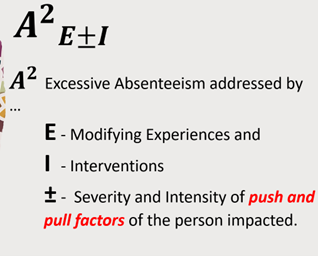
Schools are exceptional in defining and implementing interventions to create outcomes. However, there has never been a true formula simply to enable good or better outcomes for students versus old models of increased punishment. I offer one formula to aid in decision making. Assume A squared is defined as excessive absenteeism and our discussion on experiences and interventions. Then the formula would read A2 E + I.

Formula

Adjusting the Narrative of Control

The assumption being that anytime we have high rates of excessive absenteeism we would first aim to modify the student experiences in and out of school through interventions that are dialed up or down based on the severity and intensity of the push and pull factors impacting the student. In doing so we are clear that we know no number of in-school incentives will work with the student is absent and that holistic and targeted interventions are the best for the students where emphasize attention to people and services out-of-school to reengage through support, build school bonds, and better relationships. In the end control matters. Students who have moved from direct control to internal control do not respond to rewards and punishment nor pro-social relationships but to their own personal compass. As such, to reclaim them we must do the reverse. We must first appeal to their personal compass, what is important to them through out-of-school supports. Move into building pro-social relationships, which eventually moves them under a surveillance of influence where rewards and punishment can make an impact on decision-making.

Positive outcomes however depend on partnerships. Consider cross-system streaming to share and connect to out-of-school interventions and supports. When doing the intervention via:

DIY – Do. It. Yourself Method:

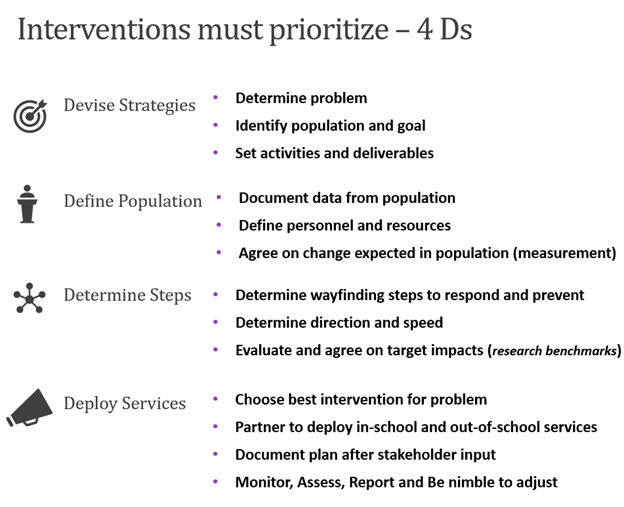
Be sure to leverage the current data you have and use the formula presented herein. Be sure to Devise, Define, Determine, and Deploy

4 D's

CURRENT EXAMPLES:

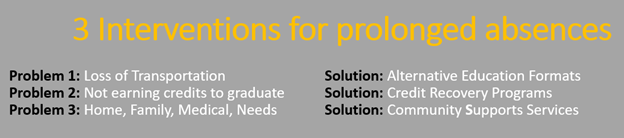
When using a method already in place it is important to ensure that there is a direct match between the defined problem and Solution like the examples below.

3 Interventions for prolonged absences

EMERGING PRACTICES:

There are many organizations responding to how to effectively meet students where they are. One area is in socio-emotional learning. Some have used training of staff and personnel (like GCSORED)while others have used technology, AI, and other software like (Fight for Life Foundation). The goal is the same identify the problem and match with solution to enable measurement.

2 Emerging Interventions

Relationships vs Punishment

Sadly, most interventions have been negative and punitive. We have data to show interventions like PBIS, MTSS, Science of Reading, Extra Curricular, etc. can change behavior but many times, we cannot define if the problem for which it was instituted has been solved. We must use the right type of interventions at the right time to make the best impact. Build relationships!

Dr. Carolyn Gentle-Gennity, PhD, Butler University
Carolyn Gentle-Genitty, PhD | Indiana University School of Social Work | cgentleg@iu.edu

About the Author

Dr. Carolyn Gentle-Genitty, founder, lead consultant, and Chief Education Officer for Pivot Attendance Solutions, has inspired many administrators, educators, students, and school social workers as a past chair of the school’s concentration Masters Curriculum, tenured professor, and Director of the Bachelors for Social Work Program. Having worked closely with Indiana Department of Education to assist school counselors in acquiring a school counselor license and coordinating curriculum mapping and application, she knows the intricacies of working with school-community partnerships. She has been a forerunner in responding to school absenteeism, truancy, and social bonding. She has over 30 years in youth development, 20 years in dropout and truancy and more specifically she brings over 12 years studying, researching, presenting, and writing about absenteeism locally, nationally, and internationally. In the US she is a leader in absenteeism and understanding school attendance problems and translating such into practice models for implementation. She is forging partnerships in colleges to establish the area as a formal field of study.

Federal & State Funding Opportunities

Understanding the world of education finance can be daunting for even the most seasoned of school and district leaders. The good news is, you don’t need to be a financial wizard to make fiscal decisions that will last a lifetime for your students by investing in attendance tracking and improvement technology. Implementing a robust digital platform that includes proactive and reactive strategies, multi-tiered interventions, high quality real time data, and two-way communications has proven to be the most effective approach to truancy abatement.

While chronic absenteeism preceded the pandemic and ballooned during, it has not quite bounced back in the aftermath (if we can even say we have fully reached post-pandemic status). According to the National Center for Education Statistics (July 6, 2022) “Compared to a typical school year prior to the start of the COVID-19 pandemic, 72 percent of U.S. public schools reported an increase in chronic absenteeism among their students. So, what’s happening? That’s what we’d all like to know. 

Attendance Tracking

Discovering the root causes of absenteeism, school refusal, chronic truancy, avoidance, or whatever other terms exist to describe the post-pandemic epidemic of student non-attendance is essential before allocating funding to address the issues. Since we know that there is no single or predominant reason, but rather an intricate mix of ingredients that contribute to truancy behaviors, addressing the problem systemically requires multi-pronged approaches. If we can reframe non-attendance as a symptom rather than “the problem” we can get closer to addressing the core of why many students have not returned post-pandemic. And only then does the conversation about resource allocation follow. 

Most schools and districts have not seen these incredible amounts of education funding coming through to mitigate the impacts of the Covid-19 pandemic in decades, if ever. Even so, dollars remain limited and often time-bound, so it’s important to leverage short-term activities with an eye on long-term solutions for attendance improvements. Distinguishing between limited-term revenue and ongoing funding can help leaders determine appropriate and sustainable allocations. 

Simply put, one-time dollars, otherwise known as “soft money” should only be spent on actions or items that are expected to fulfill short-term purposes. Ongoing dollars can be relied on for longer term applications. Covid relief funds, for example, such as the Coronavirus Aid, Relief, and Economic Security (CARES) Act, Coronavirus Response and Relief Supplemental Appropriations (CRRSA) Act, American Rescue Plan (ARP) Act, and Governor’s Emergency Relief Programs (GEER), all have a shorter shelf life than the annually distributed Elementary and Secondary Education Act (ESEA) Title I-IV funds. 

When adopting an attendance monitoring program, consider braiding different funding streams to cover your initial costs with limited-term funding, such as professional development and training, hardware purchases, technology infrastructure or upgrades, attendance incentive campaigns, or technical support. After you get up and running, ongoing funding can be used to pay for annual licensing/contracts for attendance and student information systems, support staffing, interventions, and communications. 

In my experience, most school and district leaders, outside of business services departments, confess that managing budgets is their least favorite part of the job—and one they weren’t often explicitly trained for. 

Try inverting your thinking from the traditional approach… 

“We have a grant allocation of $500,000 that lasts for three years; what can we buy?” 

…To a different mindset: “We have two major attendance issues to address—one for long-term truants and one for students who were previously attending but stopped after the pandemic.” Then ask these questions: 

  • What tools do we need to monitor and communicate attendance issues effectively?
  • Which funding sources can we tap that will address each major problem?
  • What kinds of support are necessary to move the needle for each group? 

Once you’ve asked and answered those questions, then the dollars will follow. And your inquiry before investment will pay off in the best ways for the students you serve.

About the Author

Kim Wallace, Professional Educational Consultant & Author at Process Makes Perfect

Born and raised in an educator household, Dr. Kim Wallace started her own career in public education 30 years ago as a high school English and history teacher before becoming a site principal and district office administrator. Her most recent K-12 role was as superintendent of one of the 20 largest school districts in California. 

Kim joined the UC Berkeley School of Education Leadership Programs division as the Associate Director of the 21st Century California School Leadership Academy (21CSLA) State Center in 2020. She also runs her own consulting company Process Makes Perfect, specializing in real world solutions for practitioners in the field. Kim consults, writes, and presents internationally on systems change and emerging trends in educational leadership. An award-winning, innovative educator, Kim leverages her abilities in educational administration, program management, and relationship development to optimize institutional effectiveness and deliver remarkable results.

Dr. Wallace’s book Leading the Launch: A Ten-Stage Process for Successful School District Initiatives was published by Solution Tree Press in 2021, followed by Leading Through an Equity Lens in 2023. Her upcoming book, Gamechanging Leadership in Action: An Educator’s Companion is in production with Routledge/Taylor & Francis (Fall 2025). Kim attended the University of California Santa Barbara for her undergraduate degree in history. She then earned her Master’s in Education (M.Ed.) at the University of California Los Angeles and culminated her educational goals with a Doctorate in Education (Ed.D.) from the University of California Davis.